
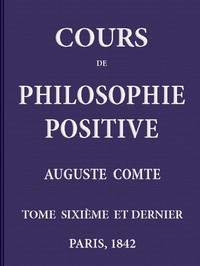
Cours de philosophie positive. (6/6) by Auguste Comte
Let's be clear: this isn't a novel. Auguste Comte's 'Cours de philosophie positive' is the six-volume culmination of his life's work, and this final book is where he brings it all home. Think of it as the grand finale of a very long, very intense lecture series. Comte walks us through his 'Law of Three Stages,' arguing that human thought and society have evolved from the Theological (where gods explain everything), to the Metaphysical (where abstract ideas like 'nature' take over), and finally to the Positive stage. This last stage is his big pitch: a world where only verifiable scientific knowledge counts, and where a new science he called 'sociology' would be queen, organizing society for the good of all.
The Story
The 'plot' is the unfolding of Comte's argument. He systematically reviews all the sciences—from math and astronomy to biology—showing how each has already entered the Positive stage. Then, he gets to the climax: the creation of sociology as the capstone science that will finally unify human knowledge and guide our social and political lives. He imagines a future governed by experts and scientists, free from the chaos of old ideologies. The final chapters lay out the practical and moral implications of this new world, proposing a 'Religion of Humanity' to give people a sense of shared purpose without the supernatural.
Why You Should Read It
I found this book incredibly provocative. Comte's confidence is either inspiring or unnerving. He's trying to build a complete operating system for civilization from scratch. You can see the fingerprints of his ideas everywhere today—in our faith in experts, in data-driven policy, even in the way we talk about 'social science.' Reading him directly, especially in this final volume, shows you where that modern mindset came from. You also see its blind spots and dangers. His vision is deeply humane in its goal of progress, but it can feel cold and controlling. It made me question how much we still live in Comte's shadow, for better or worse.
Final Verdict
This is a challenging but rewarding read for the intellectually curious. It's perfect for anyone interested in the history of ideas, the roots of modern sociology, or the grand projects of the 19th century. You don't need to be a philosopher; you just need patience for big, sweeping arguments. If you've ever wondered how the scientific worldview came to dominate modern life, this book is a crucial piece of the puzzle. It's not a light read, but it's a foundational one. Approach it like a historical document—a powerful, flawed, and ambitious blueprint for the world we now inhabit.
You are viewing a work that belongs to the global public domain. Feel free to use it for personal or commercial purposes.
Jennifer Thomas
6 months agoI've been looking for a reliable source on this topic, and the argument presented in the middle section is particularly compelling. Top-tier content that deserves more recognition.
Matthew Smith
1 year agoIt took me a while to process the complex ideas here, but the logic behind each conclusion is easy to follow and verify. I feel much more confident in my knowledge after finishing this.
David Rodriguez
1 year agoBefore I started my latest project, I read this and the author doesn't just scratch the surface but goes into meaningful detail. Finally, a source that prioritizes accuracy over hype.
Liam Martinez
2 years agoHonestly, it challenges the reader's perspective in an intellectual way. I couldn't put it down.





Linda Wilson
5 months agoGiven the current trends in this field, the author’s unique perspective adds a fresh layer to the discussion. Simple, effective, and authoritative – what else could you ask for?