About 92 minutes
Griselda: a society novel in rhymed verse — Context and Discussion
Historical Psychological Social Fiction
20,962 recorded words. 26 minutes difference from this book's estimate.
View Gutenberg source #43066
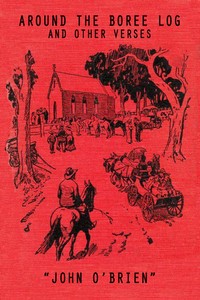
The source record for Around the Boree Log, and Other Verses — A Closer Reading measures this digital text at 26,950 words, 1 hr 58 min estimated reading time, and 5 detected text sections.
The text analysis averages about 29.8 words per sentence, while the detected sections provide another way to judge how the source is divided.
Project Gutenberg metadata also associates the work with “Australian poetry,” connecting these edition facts with the source record’s subject description.
Explore this collection
These alternatives are selected using recorded categories and estimated reading time.
About 92 minutes
Historical Psychological Social Fiction
20,962 recorded words. 26 minutes difference from this book's estimate.
View Gutenberg source #43066About 78 minutes
Historical Psychological Social Fiction
17,866 recorded words. 40 minutes difference from this book's estimate.
View Gutenberg source #28260About 62 minutes
Historical Psychological Social Fiction
14,110 recorded words. 56 minutes difference from this book's estimate.
View Gutenberg source #49658Search stored excerpts and compare books → Choose by your preferences →
Choices use stored catalog measurements. Estimates vary with reading speed. A shared category is a catalog label, not a claim that two books have the same argument or literary quality.
Search reads excerpt text stored with this catalog and links to its associated Gutenberg record. The connection is stored in the site database; this tool does not recheck that every excerpt is word-for-word identical to that external record. Excerpt search does not cover every chapter and does not verify historical publication dates.
Catalog snapshot checked: 2026-09-25. Coverage: 95 public books, 95 available source excerpts.
Read the complete public-domain text at its original source.
Read on Project GutenbergJohn O'Brien's Around the Boree Log, and Other Verses presents a series of narrative poems that draw heavily on the dialect and social world of Irish-Australian Catholics in early twentieth-century rural New South Wales. The catalog subjects list 'Australian poetry' and 'Australia -- Social life and customs,' but the excerpts reveal a more specific focus: the daily routines, hierarchies, and tensions within a Catholic parish community. The poems are populated with priests, altar boys, housekeepers, and local eccentrics, and their concerns are overwhelmingly local—the state of the presbytery, the arrival of a circus, or the antics of a dog. The broader Australian landscape appears only as backdrop; the real setting is the church, the school, and the homes of the faithful.
The poems employ a thick Irish-Australian vernacular, with words like 'sthreel' (slattern), 'boogathiel' (uncomfortable), and 'keershuch' (similar to sthreel) glossed in footnotes. This dialect is not merely decorative; it distinguishes characters by class and origin. In 'Norah O'Neill,' the speaker's irritation is conveyed through colloquial rhythms: 'That Norah O'Neill is a sthreel, / And I'm talking the way that I feel.' The footnotes suggest the poet anticipated a readership unfamiliar with these terms, positioning the poems as ethnographic records as much as literary works.
Several poems revolve around the presbytery—the priest's residence—as a site of conflict and comedy. 'Teddo Wells, Deceased' traces a former horse trainer's fall from prosperity to menial work 'groomin' for the priest,' while 'Josephine' (from the table of contents) hints at a housekeeper's disruptive presence. The presbytery dog, described as 'a hairy old scoundrel as ugly as sin,' is 'by every good soul in the parish accursed.' These poems present the church not as a serene sanctuary but as a domestic space fraught with petty power struggles and class distinctions.
The collection builds a cast of recurring figures: Father Pat, the altar-boy McEvoy, the tidy little Miss McCroddie, and the pessimistic Hanrahan (famous for 'We'll all be rooned'). These characters appear across multiple poems, creating a sense of a shared world. The poems often adopt a first-person voice—a parishioner, a former altar boy, or a down-on-his-luck groom—giving the reader access to community gossip and internal hierarchies. This technique, visible in 'Said Hanrahan' and 'The Altar-Boy,' makes the social dynamics feel immediate and lived.
Readers approaching Around the Boree Log should set aside expectations of a broad survey of Australian life. The poems are best read as a series of linked character sketches and anecdotes, rooted in a specific religious and ethnic subculture. The dialect and local references reward slow reading, and the footnotes are essential for full comprehension. This is a work that illuminates a particular community from within, rather than a panoramic view of a nation.
Leafing through O’Brien’s parishioners, I felt that same gentle ache for lives bound by faith and place, stray souls finding their footing. It reminded me of another wanderer, the little foundling Johnny, whose clumsy steps toward belonging echo those quiet M’Garritys. Somehow, both books hold the same soft light—The History of Johnny Quæ Genus, the Little Foundling of the Late Doctor Syntax. A Poem by the Author of the Three Tours. — Background and Themes—a kindness for the lost, told without hurry.
Capture what you thought, learned, and would like to remember.









