
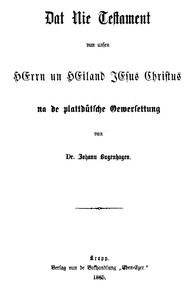
Dat Nie Testament vun unsen Herrn un Heiland Jesus Christus by Johann Bugenhagen et al.
Let's be clear upfront: this is a review of the historical artifact, the translation itself, not the theological content of the New Testament. The plot, so to speak, is the story of its creation.
The Story
In the early 1520s, a Lutheran reformer named Johann Bugenhagen worked on translating the New Testament into Low German. This wasn't High German, the language that would eventually become modern standard German. This was Plattdeutsch, the regional language of northern Germany. The goal was stunningly simple and profoundly disruptive: to get the Bible out of church Latin and into the hands and hearts of everyday people in a language they actually spoke at home and in the fields. It was published repeatedly in the 1520s, often with Luther's famous High German translation running in parallel columns. This book was a tool, a weapon, and a gift, all rolled into one.
Why You Should Read It
You don't need to read Low German to appreciate this. Looking at a page—seeing the familiar names like 'Jesus Christus' next to the distinctive, earthy sounds of Plattdeutsch—is powerful. It makes the Reformation feel real, not just a chapter in a history book. It takes this world-shaking event out of the realm of princes and theologians and plants it firmly in the marketplace and the kitchen. The very existence of this book shouts that faith and profound ideas aren't just for the educated elite. There's a deep, democratic heart to this project that still resonates. It reminds us that access to foundational texts, in your own language, is a freedom that was hard-won.
Final Verdict
This is a niche treasure, but a powerful one. It's perfect for history buffs who want to move beyond dates and battles to touch the cultural engine of the Reformation. It's for language lovers fascinated by dialects and translation. And it's for anyone who's ever thought about the raw power of making important ideas accessible. It's not a page-turning novel, but as a historical document, it's absolutely gripping. You're not just reading a Bible; you're holding a piece of a revolution.
This publication is available for unrestricted use. Enjoy reading and sharing without restrictions.
Sarah White
4 months agoHaving read the author's previous works, the way the author breaks down the core concepts is remarkably clear. The price-to-value ratio here is simply unbeatable.
Margaret Thompson
1 year agoClear, concise, and incredibly informative.
Logan Martinez
8 months agoEnjoyed every page.
William Thomas
2 years agoBased on the summary, I decided to read it and the arguments are well-supported by credible references. Absolutely essential reading.

Christopher Lee
3 months agoI wanted to compare this perspective with traditional views, it manages to maintain a consistent flow even when discussing difficult topics. Top-tier content that deserves more recognition.