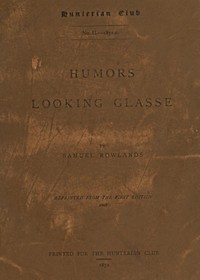
Samuel Rowlands' Humors Looking Glasse (1608) presents itself as a mirror held up to the 'mad conceited shapes' of London society, a series of epigrammatic portraits that catalogue the follies and affectations of the age. The opening address to 'Master George Lee' frames the work as a private gift of 'strange sights' and 'antique works of humours vaine delights,' yet the poems quickly move into public spaces—the barber's chair, the Exchange, the playhouse—where social performance is on display. Rowlands' speaker adopts a tone of wry observation, inviting readers to 'beholde their fashions, heare their voice, / And let discretion make thy choice.' The catalog subjects classify the work as English poetry and satire, but the excerpts reveal a more specific interest: the gap between self-presentation and reality, especially among those who 'weare ragged robes with such huge gastly slits' while claiming to be 'brave renowned wits.'
Epigrammatic Portraiture and Social Types
The excerpts show Rowlands working in a compressed, epigrammatic form that isolates a single character or situation for ridicule. The 'Scholer newly entred marriage life' is a two-stanza vignette: his wife complains of neglect, wishes to be transformed into a book, and is told she would best be an almanack 'because every yeare wee have a new you knowe.' The joke turns on the husband's literalism and the wife's failed attempt at romantic metaphor. Similarly, the 'straunge sighted Traveller'—a 'gentle bred' country fool—comes to London with a servant who shows him 'Great tall Pauls Steeple and the royall-Exchange' before robbing him. The poem's punchline, that he 'swore in London he had seene the Devill,' collapses the distinction between naive wonder and urban predation. These portraits are not developed characters but representative types, each illustrating a specific 'humor' or ruling passion.
The Mirror as Moral Instrument
The title's 'Looking Glasse' is a conventional Renaissance metaphor for satire: the poet holds up a mirror so that readers may see their own faults. Rowlands makes this explicit in the prefatory epigram, where he anticipates critics who 'with any thing he sees, a fault wil finde' and offers to 'fall to mending when the fault is found.' Yet the mirror is also literalized in the barber-shop scene described in the opening: 'As many antique faces passe, / From Barbers chaire unto his glasse, / There to beholde their kinde of trim.' The barber's glass shows physical appearance; Rowlands' glass shows moral deformity. The poems repeatedly dwell on clothing, posture, and accessories—'my feather flourish with a grace,' 'this dooble sette become my face,' 'my hose circumference profounde'—as outward signs of inner vanity. The satire works by letting the reader see the discrepancy between the character's self-regard and the poet's deflating commentary.
Urban Spaces and Social Performance
Rowlands' London is a stage where characters perform for an audience of fellow citizens. The Exchange, where 'Marchants greete, / Confusion of the tongues do meete,' is a site of multilingual commerce and deception: one character 'tels strange newes his humor is to lie' and is invited home for 'good cheare.' The playhouse appears as a place where 'Mounsieur Humor' has 'walk'd about Duke Humphries tombe / And sat amongst the Knights to see a play.' The city's landmarks—Paul's Steeple, London Stone, the Lyons in the Tower—are reduced to tourist attractions for the gullible. Even the private space of the scholar's study is invaded by domestic complaint. The poems map a social geography in which every location offers an opportunity for exposure: the barber's chair, the street, the counter (debtor's prison). Rowlands' satire is less concerned with moral reform than with the pleasure of recognizing familiar types in a distorted glass.
Readers approaching Humors Looking Glasse should attend to the interplay between the poems' surface simplicity and their layered ironies. Rowlands often ventriloquizes his targets, allowing them to condemn themselves through their own words. The epigrams reward rereading: a joke about a cuckold or a spendthrift may pivot on a single word or a pun. The 1608 text, reprinted here with modernized typography, preserves the rhythms of early modern speech and the sharp edges of Elizabethan satire. This is not a systematic treatise on humors but a collection of snapshots—a gallery of fools worth visiting for its linguistic energy and its unsparing eye.
Reading Rowlands' gallery of gulls and gallants, I remembered my grandfather’s copy of Rubáiyát of Doc Sifers — Key Ideas to Explore, dog-eared at a page about country wisdom. Both books share that tender, wry ache for a simpler world, watching fools stumble while knowing we’re often the fool ourselves. It’s a strange comfort, recognizing our own reflection in centuries-old mirrors.