
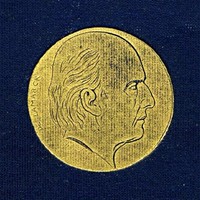
Lamarck, the Founder of Evolution: His Life and Work by A. S. Packard
Most of us know the story: Charles Darwin sailed on the Beagle, saw some finches, and discovered evolution. But what if that's only half the story? In Lamarck, the Founder of Evolution, Alpheus Spring Packard makes a compelling case that the real pioneer was a French naturalist working in the shadow of the Napoleonic Wars.
The Story
This isn't a novel, but it reads with the drive of one. Packard traces Lamarck's life from his early days as a soldier and aspiring botanist to his later, controversial role as a professor at the French National Museum of Natural History. We see Lamarck developing his radical theory: that life isn't static, but constantly striving to become more complex. He proposed that animals change because of their needs (think a giraffe stretching its neck for leaves), and that these changes could be inherited. For this, he faced constant mockery from powerful contemporaries, most notably the famous anatomist Georges Cuvier, who championed the idea that species were fixed and unchanging. The book follows Lamarck into old age, blind and poor, dictating his final works to his daughter, while his ideas were sidelined by history.
Why You Should Read It
I picked this up thinking it would be a dusty old biography. I was wrong. It's a gripping tale of scientific injustice. Packard, writing in 1901, is clearly frustrated that Lamarck has been reduced to a footnote—the guy who was 'wrong' about giraffe necks. He paints Lamarck as a tragic, visionary figure who saw the truth but lacked the social standing or forceful personality to make it stick. Reading it, you start to question the neat narratives we're taught. It makes you wonder: how many other brilliant ideas have been lost because the wrong person championed them? The book is also a fascinating look at how science works (and sometimes doesn't work) as a human enterprise, full of ego, politics, and chance.
Final Verdict
This is a must-read for anyone curious about the history of ideas, not just science. It's perfect for history buffs who enjoy a good redemption story, for readers who like seeing the underdog get their due, and for anyone who's ever asked, 'But who came before the famous guy?' It's a specialized topic, but Packard's passionate advocacy makes it accessible and surprisingly urgent. You'll close the book with a new name to remember and a much richer understanding of how big ideas are born.
This content is free to share and distribute. Access is open to everyone around the world.
Donald Gonzalez
11 months agoWow.







Brian Williams
7 months agoAfter hearing about this author multiple times, the author's voice is distinct and makes complex topics easy to digest. I couldn't put it down.