About 42 minutes
Hero and Leander — A Reader’s Guide
Fantasy Juvenile Worlds
9,481 recorded words. 2 minutes difference from this book's estimate.
View Gutenberg source #18781
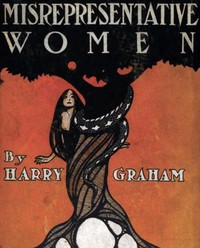
The source record for Misrepresentative Women — Reading Notes measures this digital text at 10,012 words, 44 min estimated reading time, and 2 detected text sections.
The text analysis averages about 22.8 words per sentence, while the detected sections provide another way to judge how the source is divided.
Project Gutenberg metadata also associates the work with “Nonsense verses,” connecting these edition facts with the source record’s subject description.
Explore this collection
These alternatives are selected using recorded categories and estimated reading time.
About 42 minutes
Fantasy Juvenile Worlds
9,481 recorded words. 2 minutes difference from this book's estimate.
View Gutenberg source #18781About 40 minutes
Fantasy Juvenile Worlds
8,991 recorded words. 4 minutes difference from this book's estimate.
View Gutenberg source #1062About 49 minutes
Fantasy Juvenile Worlds
11,123 recorded words. 5 minutes difference from this book's estimate.
View Gutenberg source #10122Search stored excerpts and compare books → Choose by your preferences →
Choices use stored catalog measurements. Estimates vary with reading speed. A shared category is a catalog label, not a claim that two books have the same argument or literary quality.
Search reads excerpt text stored with this catalog and links to its associated Gutenberg record. The connection is stored in the site database; this tool does not recheck that every excerpt is word-for-word identical to that external record. Excerpt search does not cover every chapter and does not verify historical publication dates.
Catalog snapshot checked: 2026-09-25. Coverage: 95 public books, 95 available source excerpts.
Read the complete public-domain text at its original source.
Read on Project GutenbergThe volume opens not with a poem but with a 'Publishers' Preface' that parodies the convention of praising an author. The speaker claims the poet's work is 'trying to a delicate inside' and that his verses are 'politer' than Kipling's or Browning's—though the self-deprecation is undercut by the boast that his methods are 'admittedly unique.' This ironic framing primes the reader for a collection where mock-heroic tone and deliberately bad rhymes are the point.
The first poem, 'Eve,' introduces a pattern of taking a well-known figure and reducing her to absurd domestic or social concerns. The excerpt shows Eve's wardrobe as 'extremely small' and her needs 'simple,' a bathetic treatment of the biblical first woman. Graham's voice relies on forced rhymes (e.g., 'need' / 'indeed') and a singsong meter that undercuts any serious subject.
Graham's satirical method is consistent across the excerpts: he applies elevated, pseudo-epic language to trivial or mundane subjects. In 'Lady Godiva,' the phrase 'At the Heart of her spouse she continued to storm' turns a legendary act of protest into a marital squabble. The poem 'Mrs. Grundy' likely continues this by deflating the figure of social propriety. The 'Publishers' Preface' sets the template by comparing the poet unfavorably to Austin Dobson, Andrew Lang, and Swinburne—only to claim his work is 'unique.' This self-aware mediocrity is the engine of the humor.
The targets are not just historical women but literary and social institutions. 'Miss Marie Corelli' and 'Mrs. Mary Baker Eddy' suggest Graham took aim at popular authors and religious figures. The reader should watch for how each poem uses a single conceit—like Eve's wardrobe or Lady Godiva's storming—to collapse grandeur into the everyday.
Graham's verse is characterized by forced rhymes and metrical irregularities that seem intentional. In 'The Self-Made Father to His Ready-Made Son,' the father's advice is undercut by the final request: 'Now, will you kindly pass the port?' The rhyme scheme often strains—'throttle' / 'bottle,' 'fall' / 'October'—and the poet splits words across lines ('Caledo- / -Nian Meetings'). This technique, announced in the preface as breaking 'Ev'ry rule of English grammar and of style,' becomes a running joke.
The reader should note how the awkwardness serves the satire: the father's moralizing is exposed as hypocritical by the very form of the poem. Similarly, 'An Epithalamium' uses the wedding of a 'free Republican Princess' to mock both royal pomp and the press, with lines like 'How glad the happy pair must be / That Hymen's bonds have set them free!' The rhyme of 'be' and 'free' is too pat, hinting at the couple's actual captivity.
'The Author to His Hostess' directly addresses the social position of the writer. The epigraph from a Current Magazine article notes that English men of letters are treated with 'insistent affability' but hold an insecure position. The poem then accuses the hostess of insincerity: 'Your compliments were insincere, / Your hospitality was mere / “Insistent affability!”' This self-referential turn makes the poet a character in his own satire, a figure of 'adamantine cheek' who sees through the social game even as he plays it.
Other poems extend this critique. 'On the Decline of Gentility Among the Young' and 'Lochinvar' (a parody of Scott) likely mock changing manners and romantic clichés. The recurring figure of the poet as an outsider—invited but not respected—ties the collection together. The reader should consider how Graham uses the first-person voice to blur the line between author and persona.
The collection moves from biblical (Eve) and legendary (Lady Godiva) figures to contemporary ones (Miss Marie Corelli, Mrs. Mary Baker Eddy) and finally to social types (Mrs. Grundy, Dame Rumor). The later poems, such as 'The Cry of the Children' and 'The Cry of the Elders,' suggest a shift toward broader social commentary, though the excerpts do not reveal their content. The book ends with 'Abbreviation's Artful Aid' and an 'Author's Aftword,' framing the whole as a playful exercise.
One recurring thread is the tension between public and private selves. 'An Epithalamium' contrasts the public spectacle of a royal wedding with the couple's desire for privacy ('Alone at last, and safely screen’d / From onslaughts of the kodak-fiend!'). Similarly, 'The Self-Made Father' presents a private letter that undercuts public morality. The reader may find that the poems reward attention to these contrasts between stated and actual values.
Reading Misrepresentative Women as a sequence rather than a random assortment reveals how Graham builds his satire through repeated techniques: the mock-heroic voice, forced rhymes, and a self-deprecating persona. The poems are best approached with an ear for the deliberate awkwardness and an eye for the social critique beneath the humor. The illustrations by Dan Sayre Groesbeck, though not excerpted here, likely complement the tone. This edition preserves the original 1906 text, including the author's own footnotes and the 'Publishers' Preface,' which together frame the work as a knowing, if uneven, performance.
Years shelving Graham’s jabs at vanity, I often recall how his Misrepresentative Women pins folly with a wink. Beside it, though, rests a gentler spell—the old tale where St. Dunstan turns the Devil’s pride into a plain horseshoe’s luck. Both whisper that human nonsense, laughed at or iron-forged, finds its quiet charm. The Horse Shoe The True Legend of St. Dunstan and the Devil, Showing How the Horse-Shoe Came to Be a Charm against Witchcraft — A Closer Reading keeps that same knowing, unhurried company on my shelf.
Use these questions to collect your thoughts before moving on.









