About 95 minutes
Courtship of Miles Standish Minnehaha Edition — Reading Companion
Adventure Picaresque Fiction
21,705 recorded words. 9 minutes difference from this book's estimate.
View Gutenberg source #54414
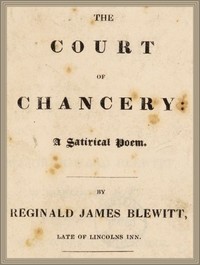
The source record for The Court of Chancery: a satirical poem. — Reading Notes measures this digital text at 19,749 words, 1 hr 26 min estimated reading time, and 5 detected text sections.
The text analysis averages about 21.8 words per sentence, while the detected sections provide another way to judge how the source is divided.
Project Gutenberg metadata also associates the work with “Great Britain. Court of Chancery -- Humor,” connecting these edition facts with the source record’s subject description.
Explore this collection
These alternatives are selected using recorded categories and estimated reading time.
About 95 minutes
Adventure Picaresque Fiction
21,705 recorded words. 9 minutes difference from this book's estimate.
View Gutenberg source #54414About 97 minutes
Adventure Picaresque Fiction
22,239 recorded words. 11 minutes difference from this book's estimate.
View Gutenberg source #57417About 67 minutes
Adventure Picaresque Fiction
15,403 recorded words. 19 minutes difference from this book's estimate.
View Gutenberg source #59216Search stored excerpts and compare books → Choose by your preferences →
Choices use stored catalog measurements. Estimates vary with reading speed. A shared category is a catalog label, not a claim that two books have the same argument or literary quality.
Search reads excerpt text stored with this catalog and links to its associated Gutenberg record. The connection is stored in the site database; this tool does not recheck that every excerpt is word-for-word identical to that external record. Excerpt search does not cover every chapter and does not verify historical publication dates.
Catalog snapshot checked: 2026-09-25. Coverage: 95 public books, 95 available source excerpts.
Read the complete public-domain text at its original source.
Read on Project GutenbergBlewitt opens his 1827 poem with a Byron epigraph that sets a tone of moral outrage: 'When justice halts, and right begins to fail.' The preface then declares the work a 'tomahawk of censure' against the 'great delay and ruinous expenses of a Chancery suit.' This is no abstract complaint; the poem immediately personifies the court as a 'monster' and an 'engine of oppression,' using legal terminology—'estates for life,' 'remainders,' 'uses,' 'trust'—as the raw material for satire. The reader is plunged into a world where lawyers are conjurers and the law itself a form of dark magic.
Blewitt, 'late of Lincoln's Inn,' writes from within the profession. In the preface he admits sacrificing 'every literary attainment to the study of the law' for ten years, comparing himself to a miner emerging from underground. This insider perspective gives the satire a technical precision: he knows the difference between an estate in fee and a life estate, and he can mock the 'mystic lore' of conveyancers like Fearne and Preston. The poem's voice is that of a disillusioned practitioner, not an outsider. When he describes a lawyer who 'conjure doubts, to breed dismay, / And hunt, a jackall, for the lions prey,' the metaphor is both vivid and legally informed. The reader benefits from recognizing that the poet's anger is grounded in firsthand experience of Chancery's machinery.
The poem's middle sections introduce a rogues' gallery of legal figures. Preston, a real-life conveyancer, is dissected with surgical mockery: 'He lisps—did not Demosthenes the same?' The comparison is deliberately absurd, and Blewitt follows it with a string of couplets that reduce Preston to a vain, ephemeral figure whose 'glory into air hath flown.' The courtroom scene between Bell and Horne is pure farce. Bell stutters and relies on circular logic ('right is right'), while Horne 'sputters nonsense in a speech of fire.' The humor depends on the reader's willingness to see legal argument as a performance stripped of reason. Blewitt's couplets are tight and epigrammatic, each line driving a nail into the coffin of legal dignity. The satire works not by exaggeration alone but by the accumulation of specific, recognizable behaviors.
The excerpts suggest a clear three-part movement. The opening establishes the court as a monstrous entity and introduces the poet's moral stance. The middle sections shift to individual portraits—Preston, Bell, Horne—each a type of legal folly. The later excerpts, though incomplete, appear to return to systemic critique, with the preface's promise of 'truth and consistency' guiding the whole. Blewitt signals his method early: 'I have thrown into the work as much amusement as my poor abilities would furnish me with, but my principal objects have been truth and consistency.' The reader should watch for how the poem alternates between general indictment and specific character sketch. The couplet form itself becomes a tool of control, each closed rhyme delivering a verdict. The poem's 19,749 words move at a brisk pace, and the satirical targets are never far from view.
Blewitt is careful to distinguish his attack on 'vicious' attorneys from the profession at large, noting that 'there are in town and country many upright practitioners.' This qualification, placed in the preface, complicates the poem's apparent blanket condemnation. The reader must decide whether the satire is aimed at individuals or at the system that enables them. The preface also admits that the poem was composed in the Park of Fontainebleau, 'without any opportunity of referring to any publication on the subject,' relying instead on memory. This may explain occasional errors, but it also gives the work a personal, almost improvisational quality. The reader is invited to see the poem as a performance of indignation rather than a legal treatise. The 'tomahawk' metaphor suggests a desire to wound, but the weapon is wielded with a showman's flair.
Approach The Court of Chancery as a period piece that demands some tolerance for obscure legal references. The satire is most effective when read aloud, letting the couplets' rhythm underscore the mockery. Pay attention to the preface's framing—it is the key to Blewitt's intentions. The poem is not a systematic critique but a series of sharp, often funny, vignettes. Let the caricatures carry you, and do not expect a plot. The pleasure lies in the language and the audacity of the attack.
That afternoon, the rain drummed against the windows while Blewitt’s Court of Chancery made me laugh at how absurdly our institutions can calcify—a tomahawk aimed at the very idea of endless delay. Later, idly tracing that same comic vein in everyday life, my hand drifted to The True Grecian Bend: A Story in Verse — Background and Themes, and the satire softened into something gentler, almost affectionate, like watching a woman’s posture turn a sidewalk into a stage.
Capture what you thought, learned, and would like to remember.









