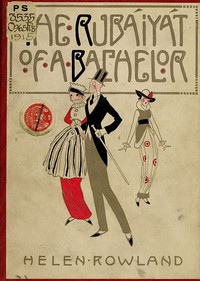
Helen Rowland's The Rubáiyát of a Bachelor (1915) is a sustained parody of Omar Khayyám's quatrains, repurposing the form to mock early twentieth-century courtship rituals. The excerpts reveal a speaker who oscillates between pleasure in flirtation and fear of the wedding ring. Rowland's bachelor narrator describes himself as a 'laggard' outside Hymen's altars, and the poems are filled with specific material details—'blue points on the half-shell,' 'iced champagne,' 'a picture hat'—that ground the satire in a recognizable social world. The dedication to her husband adds an ironic layer: the book is written by a married woman ventriloquizing a bachelor's voice.
Parody as Structure
The catalog lists this work under 'Omar Khayyam -- Parodies, imitations, etc.,' and the excerpts confirm that Rowland follows the rubáiyát form closely: four-line stanzas with an AABA rhyme scheme. But where Khayyám's speaker muses on mortality and the fleeting moment, Rowland's bachelor frets about the 'Cozy Corner test' and the danger of proposing. The opening quatrain replaces Khayyám's 'The Moving Finger writes' with a complaint about Lent's end: 'The Vows of Lent, and bids the heart be light.' The parody is not merely formal; it inverts the original's philosophical gravity into social comedy. The speaker's 'Paradise' is not a garden but a supper, a cigar, and a woman flirting 'neath a picture hat.'
The Bachelor's Voice and Its Limits
The excerpts present a consistent first-person speaker who is both boastful and anxious. He describes himself as 'blithe and gay' one moment, then 'shuddering' as he flees a woman who looks 'so different' the next. The voice is deliberately shallow: he values 'a charming Woman' as one item in a list that includes supper and cigars. Yet the catalog subject 'Bachelors -- Poetry' is complicated by the fact that the author is a woman. Rowland's dedication 'To My Husband' signals that the bachelor persona is a constructed performance. The excerpts give no evidence of the speaker's backstory or eventual fate; the poems are a series of moments, not a narrative arc. Readers should note that the voice is a satirical mask, not an autobiography.
Material Culture and Social Ritual
Rowland's quatrains are dense with period-specific objects and customs. The bachelor attires himself 'like unto Solomon' before going out, and his 'Winter garments' vanish mysteriously. Courtship happens in 'cozy-corner tête-à-tête' settings, and the ultimate threat is the 'Wedding Ring.' The catalog subject 'Humorous poetry' fits, but the humor depends on recognizing these social codes: the 'Lent' and 'Spring' contrast refers to the social season, when flirtation was permissible. The speaker's fear of being 'helpless, before the Cozy Corner test' suggests a specific domestic architecture—the cozy corner was a popular early 1900s furnishing for intimate conversation. These details anchor the satire in a particular time and place, making it more than a generic bachelor complaint.
Readers approaching The Rubáiyát of a Bachelor should attend to the gap between the catalog's straightforward subjects and the work's ironic framing. The poems are not a bachelor's authentic lament but a married woman's parody of that voice. The quatrains reward attention to their specific references—to Lent, to cozy corners, to picture hats—which ground the humor in 1915 social rituals. Treat the speaker as a character, not a confession, and the book as a light but pointed commentary on the games of courtship.
That rainy afternoon, I kept returning to Rowland’s warning about the “Cozy Corner test”—her bachelor’s terror of domestic stillness. Later, almost without thinking, I pulled down Aurora Leigh — Background and Themes, and the two voices seemed to answer each other across a century, one mocking the cage, the other quietly demanding to build it on her own terms.