About 169 minutes
Elias: An Epic of the Ages — Reading Notes
Adventure Picaresque Fiction
38,762 recorded words. 7 minutes difference from this book's estimate.
View Gutenberg source #37718
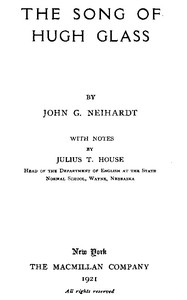
This digital edition of The Song of Hugh Glass — A Reader’s Guide is described by source-level measurements including 40,268 words, 2 hr 56 min estimated reading time, and 12 detected text sections.
The text analysis averages about 16.4 words per sentence, while the detected sections provide another way to judge how the source is divided.
Project Gutenberg metadata also associates the work with “Fur trade -- West (U.S.) -- History -- Poetry,” connecting these edition facts with the source record’s subject description.
Explore this collection
These alternatives are selected using recorded categories and estimated reading time.
About 169 minutes
Adventure Picaresque Fiction
38,762 recorded words. 7 minutes difference from this book's estimate.
View Gutenberg source #37718About 154 minutes
Adventure Picaresque Fiction
35,375 recorded words. 22 minutes difference from this book's estimate.
View Gutenberg source #7490About 153 minutes
Adventure Picaresque Fiction
35,074 recorded words. 23 minutes difference from this book's estimate.
View Gutenberg source #12384Search stored excerpts and compare books → Choose by your preferences →
Choices use stored catalog measurements. Estimates vary with reading speed. A shared category is a catalog label, not a claim that two books have the same argument or literary quality.
Search reads excerpt text stored with this catalog and links to its associated Gutenberg record. The connection is stored in the site database; this tool does not recheck that every excerpt is word-for-word identical to that external record. Excerpt search does not cover every chapter and does not verify historical publication dates.
Catalog snapshot checked: 2026-09-25. Coverage: 95 public books, 95 available source excerpts.
Read the complete public-domain text at its original source.
Read on Project GutenbergJohn G. Neihardt's The Song of Hugh Glass opens not with the famous mauling but with a gray-bearded storyteller at Kiowa, reluctant to speak yet compelled to recount a tale “as of another man.” This framing device immediately establishes a central tension: the poem is as much about the act of telling—the transformation of trauma into art—as about the historical events themselves. The narrator describes Glass’s voice as “low-toned, insistent as October rain,” and notes how his audience’s eyes “grew soft or hard” with the telling. The poem thus presents itself as a self-conscious epic, one that acknowledges the gap between raw experience and the crafted story.
The excerpts repeatedly emphasize Glass’s role as a reluctant performer. When the Bourgeois calls for a “man’s tale,” Glass begins “with little heart for revelry,” and his story is told “as of another man.” This distancing suggests a psychological split between the survivor and the legend. Neihardt’s narrator further complicates the frame by describing Glass as “something of the bard,” whose purpose is “that is art’s, / Whereby men make a vintage of their hearts.” The poem thus layers multiple storytellers: the historical Glass, Neihardt’s version of Glass, and the omniscient narrator who observes the effect on the listeners. The result is a meditation on how suffering becomes narrative, and how narrative in turn shapes identity.
The Missouri River dominates the poem’s geography, rendered as a living, hostile force. The keelboat crew toils “among the snags and bars,” “lashed by the doubt and strengthened by the hope / Of backward winter.” Neihardt’s descriptions are tactile and kinetic: the river is “like a sandy bay at ebb-tide,” then “like a flume”; the men are “engines wrought of bone / And muscle.” The landscape also holds memory. When Glass passes “the empty lodges of the Ree,” the “troubled glory of that wind-tossed hair / Was on the trampled corn,” and the skies seem “haunted with the blue of Jamie’s eyes.” Place becomes a repository of personal loss, and the physical journey is also a journey through grief.
The poem’s violence is both explicit and stylized. The climax of Glass’s tale—the cutting of the traitor’s throat—is rendered as a kind of possession: “the dizzy tale plunged on / Even to the cutting of the traitor’s throat, / And ceased—as though a bloody strangling smote / The voice of that gray chanter, drunk with doom.” The listeners shudder, and the deed seems to happen “before their eyes.” Yet Neihardt also undercuts this catharsis. Earlier, Glass’s audience grips their hands “as though each hearer had a fickle friend,” suggesting that the tale evokes not just horror but a troubling identification. The poem thus questions the ethics of enjoying such stories, even as it delivers them.
The poem is dedicated to the author’s young son, Sigurd, “scarcely three.” In the dedicatory verses, Neihardt promises that when the boy is older, he will “ply well the craft I know / Of shaping kite and boat and bow,” and meanwhile he “strive[s] to build for you the mood / Of daring and of fortitude / With fitted word and shapen phrase.” This personal frame aligns the epic’s themes of endurance and storytelling with paternal love. It also foregrounds the poet’s own craft: the “fitted word and shapen phrase” are the tools by which the raw material of frontier history is shaped into a usable past. The dedication thus mirrors the poem’s larger project of transforming violence into inheritance.
Readers should attend to the poem’s shifting registers: the colloquial energy of the keelboatmen, the elevated diction of the bardic passages, and the intimate grief of the personal frame. Neihardt’s notes, supplied by commentator Julius T. House, offer historical context but do not resolve the poem’s deliberate ambiguities about memory, guilt, and the making of legend. The Song rewards attention to its sound—the heavy rhythms of labor, the sudden silences after violence—as much as to its story.
That sense of being left alone with your own choices after the story ends—it stayed with me after reading about Hugh Glass, that raw solitude. It’s a quieter echo I felt again in The Courtship of Miles Standish: With Suggestions for Study and Notes — A Reader’s Guide, where longing itself becomes the wilderness. Something tender lingers there, like a footprint in snow.
Create a short personal record of your experience with this book.









