About 50 minutes
Mother Goose's Bicycle Tour — Themes and Context
Fantasy Juvenile Worlds
11,483 recorded words. 2 minutes difference from this book's estimate.
View Gutenberg source #54664
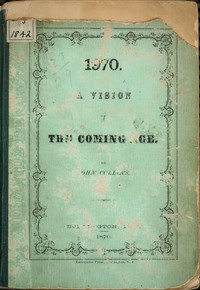
This digital edition of 1970: A Vision of the Coming Age — Text and Context is described by source-level measurements including 11,944 words, 52 min estimated reading time, and 2 detected text sections.
The text analysis averages about 27.3 words per sentence, while the detected sections provide another way to judge how the source is divided.
Project Gutenberg metadata also associates the work with “Christian poetry,” connecting these edition facts with the source record’s subject description.
Explore this collection
These alternatives are selected using recorded categories and estimated reading time.
About 50 minutes
Fantasy Juvenile Worlds
11,483 recorded words. 2 minutes difference from this book's estimate.
View Gutenberg source #54664About 49 minutes
Fantasy Juvenile Worlds
11,123 recorded words. 3 minutes difference from this book's estimate.
View Gutenberg source #10122About 58 minutes
Fantasy Juvenile Worlds
13,340 recorded words. 6 minutes difference from this book's estimate.
View Gutenberg source #1045Search stored excerpts and compare books → Choose by your preferences →
Choices use stored catalog measurements. Estimates vary with reading speed. A shared category is a catalog label, not a claim that two books have the same argument or literary quality.
Search reads excerpt text stored with this catalog and links to its associated Gutenberg record. The connection is stored in the site database; this tool does not recheck that every excerpt is word-for-word identical to that external record. Excerpt search does not cover every chapter and does not verify historical publication dates.
Catalog snapshot checked: 2026-09-25. Coverage: 95 public books, 95 available source excerpts.
Read the complete public-domain text at its original source.
Read on Project GutenbergJohn Collins's 1870 poem 1970: A Vision of the Coming Age opens with a speaker idling in a June heat, listening to telegraph wires. The date “nineteen hundred and threescore and ten” recurs as a refrain, anchoring a series of imagined messages and scenes. The poem is written in rhyming couplets of varying meter, mixing business telegrams, personal requests, and news bulletins with pastoral and industrial imagery. Collins uses the telegraph as both a plot device and a structural frame, allowing the speaker to overhear global communications and later to travel through a transformed landscape. The excerpts show a world where technology causes no harm—an exploding engine injures no one—and where Christian principles have eradicated poverty, disease, and predation. The vision is presented as a single, continuous reverie, with the speaker moving from the telegraph office to a train, then through countryside and city, observing the changes.
The poem’s opening relies on the telegraph to establish both its setting and its method. The speaker, reclining near “the tall posts of the telegraph thought-road,” claims to hear every word transmitted: “the short business message—the tale of some wrong, / An accident, not on the Jersey railway, / The prices of stocks—events of the day.” This conceit allows Collins to introduce a rapid succession of voices and locations—a merchant in Japan, a lady in Boston ordering fruit from Cuba, a wedding invitation, a summons to a dying friend. The telegraph becomes a kind of oracle, delivering news from afar and collapsing distance. The repeated line “It was ‘nineteen hundred and threescore and ten’” anchors these fragments in a specific future year. The poem thus uses the telegraph not merely as a prop but as a structural principle, generating a mosaic of vignettes that together build the utopian world.
One of the most striking episodes in the excerpts is the description of a train explosion on the Omaha plain. The engine “blew up” and “to atoms it flew, but no one was hurt, / Only some of the passengers covered with dirt.” The fireman is found “half a mile from the spot, / Safely lodged in a village,” and the engineer’s body is buried in sand except for “a part of one hand.” Yet the only damage is “a scratch on each face.” This incident exemplifies the poem’s logic: technology in the future is powerful but entirely benign. The explosion is spectacular yet harmless, a marvel of safety rather than a disaster. Collins extends this pattern to other domains: mines have fire-damp but “the light they now used created no heat,” and “the air, so mephitic of old time, became / As oxygen pure.” The poem consistently presents progress as the elimination of risk and suffering, not the absence of machinery.
As the speaker travels through the transformed countryside, the poem catalogues a world where natural and social ills have vanished. “The fox and the hare lived in the same den / On intimate terms, unmolested by men,” and “every beast, bird or fish” no longer regards each other as prey. Human institutions of charity have become obsolete: “I looked for the buildings benevolence reared— / There were none, for the paupers had all disappeared.” The blind, sick, deaf, lame, and “feeble of mind” are absent. Workshops are airy and sunlit, and the master works alongside his employees, guided by the golden rule. The landscape itself is fruitful: “the bright golden orange gleamed through the dark leaves,” and the vine and fig flourish. Collins imagines a world where Christian love has reordered both society and nature, producing a peace that extends from human relations to the animal kingdom.
Readers should note that the poem’s vision is presented as a single, uninterrupted dream, and the excerpts cover only the first half of the work. The speaker’s journey continues beyond the passages provided, and the full poem may develop or complicate the utopian picture. Collins’s reliance on the telegraph as a framing device and his repeated use of the date 1970 give the poem a rhythmic, almost incantatory quality. The work rewards attention to its small, concrete details—the scratch on the engineer’s face, the barrel of oranges, the fox and hare sharing a den—which ground the abstract ideal in specific, sometimes whimsical images.
There’s something tender about Collins’s belief that by 1970 we’d have outgrown harm, and I catch that same wistfulness in the Rubáiyát of Doc Sifers — Key Ideas to Explore, where the old certainties feel more like questions. Maybe every era needs its gentle reimagining of what peace could look like, even if only in the margins.
Create a short personal record of your experience with this book.









