About 23 minutes
A Tale of Old Japan — Background and Themes
Science Fiction Utopias
5,078 recorded words. 2 minutes difference from this book's estimate.
View Gutenberg source #63530
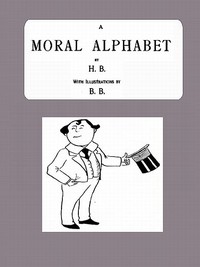
This digital edition of A Moral Alphabet — Inside the Classic is described by source-level measurements including 5,680 words, 25 min estimated reading time, and 1 detected text section.
The text analysis averages about 21.1 words per sentence, while the detected sections provide another way to judge how the source is divided.
Project Gutenberg metadata also associates the work with “Children's poetry, English,” connecting these edition facts with the source record’s subject description.
Explore this collection
These alternatives are selected using recorded categories and estimated reading time.
About 23 minutes
Science Fiction Utopias
5,078 recorded words. 2 minutes difference from this book's estimate.
View Gutenberg source #63530About 20 minutes
Science Fiction Utopias
4,492 recorded words. 5 minutes difference from this book's estimate.
View Gutenberg source #27182About 17 minutes
Science Fiction Utopias
3,754 recorded words. 8 minutes difference from this book's estimate.
View Gutenberg source #22818Search stored excerpts and compare books → Choose by your preferences →
Choices use stored catalog measurements. Estimates vary with reading speed. A shared category is a catalog label, not a claim that two books have the same argument or literary quality.
Search reads excerpt text stored with this catalog and links to its associated Gutenberg record. The connection is stored in the site database; this tool does not recheck that every excerpt is word-for-word identical to that external record. Excerpt search does not cover every chapter and does not verify historical publication dates.
Catalog snapshot checked: 2026-09-25. Coverage: 95 public books, 95 available source excerpts.
Read the complete public-domain text at its original source.
Read on Project GutenbergHilaire Belloc's A Moral Alphabet (1899) opens not with a letter but with a dedication to 'the Gentleman on page 49'—a sly nod to the book's own structure. The first poem, 'A stands for Archibald,' describes a prize-giving ceremony where a boy receives 'the Noblest Work produced as yet' upon the English alphabet. The scene is thick with detail: combed and oiled hair, a pedagogue's thunderous words, and a crowd blocking the street. Yet the moral undercuts the pomp: 'Learn from this justly irritating Youth, / To brush your Hair and Teeth and tell the Truth.' The gap between grand occasion and bathetic lesson sets the pattern for the verses that follow.
The dedication and first poem establish a ceremonial tone that recurs throughout. Archibald's award ceremony is described with mock-heroic gravity: 'The Upper School had combed and oiled their hair, / And all the Parents of the Boys were there.' The pedagogue's speech 'ring[s] like thunder through the Hall,' drawing tears and applause. Yet the moral deflates the scene, reducing the prize to a warning about personal hygiene and honesty. This tension between elevated language and trivial lesson reappears in later verses. For instance, the Bear poem presents two responses to danger—fight or flight—and concludes that 'Decisive action in the hour of need / Denotes the Hero, but does not succeed.' The formal structure of the alphabet book, with its predictable A-to-Z progression, is undercut by the unpredictability of the morals, which often refuse to reward virtue or punish vice in any straightforward way.
Physical disaster is a leitmotif. The Bear 'Devoured him, Limb by Limb' and beats the fleeing man 'by a yard.' The Cobra's bite leaves an Indian Judge with 'restless nights.' The Dreadful Dinotherium, 'a creature heavier than a whale,' insists on roosting in branches and 'tumbled (as he always did),' resulting in a fossil 'All broken up.' Falling is literal: the Dinotherium's 'claw-like toes' suggest it could not help but slide. The moral—'If you were born to walk the ground, / Remain there; do not fool around'—echoes the Bear poem's warning against decisive action. Devouring appears again in the Bear's consumption of the gentleman. These images of ingestion and descent create a pattern of bodily vulnerability, where characters are eaten, bitten, or broken by their own choices.
The poems shift abruptly between settings: a school hall, a wilderness where a bear attacks, an Indian judge's chambers, a prehistoric landscape. This movement is not geographical but tonal. The Cobra poem, for instance, is a single couplet followed by a moral that admits the creature 'Conveys no kind of Moral worth recalling.' The Dinotherium poem, by contrast, is a lengthy narrative with pseudo-scientific detail about its 'trunk, or elongated nose' and 'graminivorous' teeth. The transitions are jarring: from a boy receiving a book to a bear eating a man to a snake biting a judge to a prehistoric mammal falling from a tree. There is no connective tissue between letters; each stands alone. This structure forces the reader to recalibrate expectations with every page, as the voice shifts from mock-heroic to deadpan to absurd.
Each poem ends with a moral, but these often contradict or trivialize the narrative. The Bear's moral—'Decisive action in the hour of need / Denotes the Hero, but does not succeed'—undermines the very concept of heroism. The Dinotherium's moral—'If you were born to walk the ground, / Remain there; do not fool around'—reduces a prehistoric tragedy to a warning against ambition. The Cobra's moral admits it 'Conveys no kind of Moral worth recalling,' a self-cancelling gesture. Even the opening poem's moral—'Learn from this justly irritating Youth, / To brush your Hair and Teeth and tell the Truth'—turns a prize-winning boy into an object of irritation. These morals are not lessons but punchlines, often delivered in a tone of weary resignation. They suggest that the alphabet's order imposes a false coherence on chaotic outcomes.
Belloc's A Moral Alphabet rewards attention to its structural quirks: the gap between poem and moral, the recurrence of falling and being eaten, and the abrupt scene changes. Readers may find that the morals are best read as ironic commentary rather than sincere advice. The book's brevity—5680 words—invites multiple passes, each revealing new contradictions between the verse's mock-heroic voice and its deflating conclusions.
Reading Belloc’s verses, I remembered my father’s slow, almost liturgical recitations of grim nursery rhymes—the way a falling apple or a yawning bear could feel like a quiet moral verdict. That same strange weight hung over my evenings with A Tale of Old Japan — Background and Themes, where tradition and consequence folded together like a held breath, and I was left simply sitting with the feeling.
A brief reflection can help important ideas stay with you longer.









