
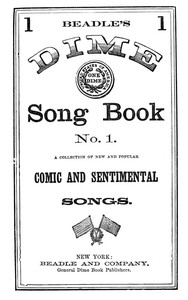
Beadle's Dime Song Book No. 1 by Various
Okay, let's clear this up first: this is not a storybook. You won't find a plot with chapters. Instead, Beadle's Dime Song Book No. 1 is a snapshot. Published in 1860, it's a cheap, pocket-sized collection of the songs that were on everyone's lips (or at least in their parlors) right before and during the American Civil War. For ten cents, you got the lyrics and simple sheet music for dozens of tunes.
The Story
The 'story' is the America you find in these pages. It's a jukebox of the national mood. You flip through and see stirring patriotic anthems ready to rally the troops right next to deeply sentimental 'heartbreak' ballads about lovers separated by war. Then, out of nowhere, you get a silly, slapstick comedy song—the kind of thing people would perform for laughs at a social gathering. There are minstrel songs (a painful but important part of the cultural record), temperance songs warning against drink, and folk tunes. There's no single narrative, just a chorus of voices from a country on the brink.
Why You Should Read It
I loved this because it makes history feel human. Textbooks tell you about tariffs and treaties. This book shows you what a homesick soldier might have been humming in his tent, or what a family sang together to lighten a dark evening. The contrast is striking and honest. It reminds you that even in the middle of a huge national crisis, people still craved a good laugh, a good cry, and a catchy tune. It's raw, unfiltered popular culture. Reading (or even trying to sing) these songs strips away 160 years of polish and lets you hear the era in its own, sometimes awkward, voice.
Final Verdict
This is a fascinating read for a specific crowd. It's perfect for history buffs who want to go beyond dates and battles, for musicians curious about old folk tunes, or for anyone who loves weird, primary-source artifacts. It's not a page-turner in the traditional sense, but more of a museum you can hold in your hand. If you've ever listened to old pop songs and wondered what they said about the time they were made, this is that concept applied to the 1860s. Just be ready for some complex and dated language—it's a product of its time, for better and worse.
No rights are reserved for this publication. Distribute this work to help spread literacy.
Paul Rodriguez
5 months agoGreat value and very well written.
Charles Lee
6 months agoA sophisticated analysis that fills a gap in the literature.
Christopher Perez
2 years agoI appreciate how this edition approaches the core problem, the chapter on advanced strategies offers insights I haven't seen elsewhere. Finally, a source that prioritizes accuracy over hype.
Karen Martin
1 year agoI stumbled upon this title during my weekend research and the way it handles controversial points with balance is quite professional. An excellent example of how quality digital books should be formatted.






Ashley Martinez
9 months agoHaving followed this topic for years, I can say that the step-by-step breakdown of the methodology is extremely helpful for students. This is a solid reference for both beginners and experts.