
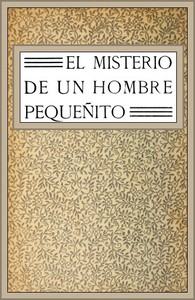
El misterio de un hombre pequeñito: novela by Eduardo Zamacois
Published in 1900, Eduardo Zamacois's novel feels both of its time and startlingly modern. It’s a social puzzle box wrapped in a very slim volume.
The Story
The plot is deceptively simple. We follow Don Zacarías, a man distinguished mostly by his exceptionally short stature and his utterly inoffensive, routine-driven life. He’s a creature of habit, polite to a fault, and wants nothing more than to be left alone. But in his small Spanish town, that’s the one thing he can’t have. For no reason he can understand, a cloud of suspicion and intrigue begins to form around him. His neighbors' polite nods turn into hushed conversations that stop when he approaches. His mundane errands are interpreted as secretive missions. A kind gesture is seen as a sign of guilt. Zacarías becomes the 'little man' at the center of a big mystery that exists entirely in the imaginations of everyone but him. The novel is the story of his confused and increasingly isolated navigation through a world that has decided he’s fascinatingly suspicious, simply because he’s different and they don't understand him.
Why You Should Read It
What I loved most is how Zamacois flips the script. Usually, a 'mystery' novel is about an active detective solving a crime. Here, the protagonist is the passive, bewildered subject of the mystery, and the whole town are the unlicensed detectives, building a case out of thin air and gossip. It’s a brilliant, often funny, and ultimately sad look at how communities can create narratives about individuals, especially those who don’t fit the standard mold. Don Zacarías isn’t a hero; he’s just a man trying to buy bread, and his struggle to exist peacefully in the face of invented drama is deeply moving. The book is less about what he did and more about what we, as a society, do to people we mark as 'other.'
Final Verdict
This is a perfect pick for readers who enjoy character studies and social satire over fast-paced action. If you like books that examine the quiet cruelties of everyday life, or if you’re a fan of authors who find the extraordinary in the ordinary (think a Spanish cousin to some of Chekhov’s shorter works), you’ll connect with this. It’s also a great, accessible entry point into early 20th-century Spanish literature. Just be prepared—it’s a quick read, but the feeling of being misunderstood that it captures lingers for a long time.
This masterpiece is free from copyright limitations. You are welcome to share this with anyone.
Margaret Wilson
6 months agoEnjoyed every page.
Steven Williams
8 months agoI had low expectations initially, however the narrative structure is incredibly compelling. One of the best books I've read this year.
Betty Smith
1 year agoRecommended.
Ashley Lee
2 years agoWow.






Charles Hill
1 year agoFrom the very first page, the character development leaves a lasting impact. Thanks for sharing this review.