About 36 minutes
Misrepresentative Men — Themes and Context
Historical Psychological Social Fiction
8,070 recorded words. 2 minutes difference from this book's estimate.
View Gutenberg source #36321
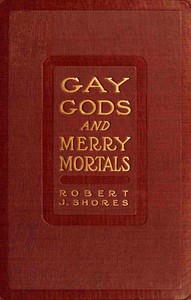
The source record for Gay gods and merry mortals: some excursions in verse — A Closer Reading measures this digital text at 7,711 words, 34 min estimated reading time, and 15 detected text sections.
The text analysis averages about 22.0 words per sentence, while the detected sections provide another way to judge how the source is divided.
Project Gutenberg metadata also associates the work with “Humorous poetry,” connecting these edition facts with the source record’s subject description.
Explore this collection
These alternatives are selected using recorded categories and estimated reading time.
About 36 minutes
Historical Psychological Social Fiction
8,070 recorded words. 2 minutes difference from this book's estimate.
View Gutenberg source #36321About 36 minutes
Historical Psychological Social Fiction
8,220 recorded words. 2 minutes difference from this book's estimate.
View Gutenberg source #61121About 39 minutes
Historical Psychological Social Fiction
8,912 recorded words. 5 minutes difference from this book's estimate.
View Gutenberg source #13649Search stored excerpts and compare books → Choose by your preferences →
Choices use stored catalog measurements. Estimates vary with reading speed. A shared category is a catalog label, not a claim that two books have the same argument or literary quality.
Search reads excerpt text stored with this catalog and links to its associated Gutenberg record. The connection is stored in the site database; this tool does not recheck that every excerpt is word-for-word identical to that external record. Excerpt search does not cover every chapter and does not verify historical publication dates.
Catalog snapshot checked: 2026-09-25. Coverage: 95 public books, 95 available source excerpts.
Read the complete public-domain text at its original source.
Read on Project GutenbergRobert J. Shores’s Gay Gods and Merry Mortals (1910) presents classical myths as brisk, rhyming anecdotes, each poem a self-contained vignette. The collection’s structure—fifteen poems bookended by a Proem—moves from Actæon’s accidental glimpse of Diana to Daphne’s flight from Apollo, with stops for Adonis, Penelope, Sappho, and others. Shores’s voice is consistently arch: he winks at the reader, inserts anachronisms (Pear’s Soap, “Lover’s Lane”), and punctuates each tale with a moral that often undercuts itself. The poems share a recurring interest in moments of exposure—bathing, undressing, or simply being caught off-guard—and in the comic friction between divine dignity and human clumsiness.
The Proem functions as both apology and advertisement. Shores announces that his book “relates” ancient tales while explaining how gods “displayed their human traits.” He compares his jingles to those of the poet Saxe and admits that some Homeric anecdotes are missing because they “would never pass the mails to-day.” The final couplet declares the collection “slightly expurgated,” a joke that frames the entire work: Shores will flirt with risqué material while maintaining a veneer of propriety. This opening establishes the poet as a self-conscious mediator between antique sources and a modern, presumably American, audience.
Several poems hinge on a character being seen unclothed or in a state of undress. In “Actæon,” the hunter stumbles upon Diana in her bath; the poem dwells on what he saw (“what he wore when he was born”) and on the goddess’s hurried attempt to cover herself. “Adonis” opens with Cupid being spanked, and the narrative later involves Venus’s “evening leaf.” “Daphne” describes a maiden who “would not flirt / Her dainty little hunting skirt.” Hunting itself appears as a framing device: Actæon pursues the Chase, Daphne devotes her days “unto the Chase,” and the chase of love is a persistent metaphor. These recurring elements—bodies exposed, garments shed or clung to, the hunt as both literal and erotic—give the collection a cohesive visual and thematic thread.
Shores’s poems often begin in a mortal setting and then pivot to divine intervention, or vice versa. In “Actæon,” a mortal hunter stumbles into a goddess’s bath; in “Adonis,” a divine quarrel (Cupid spanked by Jove) sets off a chain of events that ends with Adonis’s death. “Dido” moves from the mortal queen’s flight from Tyre to her encounter with the semi-divine Aeneas. The transitions are abrupt, signaled by line breaks or shifts in tone. Shores uses these jumps to create comic incongruity: a goddess donning her crescent “in great haste” is followed by a mortal’s banal question about soap. The effect is to collapse the distance between Olympus and everyday life, making the gods seem petty and the mortals foolish.
Each poem ends with a moral couplet or stanza, but Shores often undermines the lesson. In “Actæon,” the moral warns against “conversation, if uncouth,” but the preceding joke (the Pear’s Soap gag) is itself uncouth. In “Dido,” the poet flatly states, “The Moral? This is not a moral tale,” then offers a pun on “cutting didoes.” The morals in “Adonis” and “Daphne” are similarly flippant. This pattern suggests that Shores is less interested in instruction than in the pleasure of deflating expectations. The morals function as punchlines, not precepts, and they reinforce the collection’s tone of knowing irreverence.
Readers will find that the poems reward attention to Shores’s wordplay and his manipulation of meter. The rhymes are often deliberately strained, and the anachronisms are placed with care. Because the excerpts cover only about half the collection, the full range of mythological figures and comic strategies remains to be discovered. The book is best read as a sequence, noting how Shores varies his approach from poem to poem while maintaining a consistent, sardonic voice.
Sometimes I catch myself smiling at how freely Gay Gods and Merry Mortals lets its myths breathe, all that laughter softening the old solemnities. It reminded me, strangely, of another quiet pleasure — the way The Lay of the Sheriff — Story, Setting & Ideas lingers on its own rustic corners without hurry. Both feel like evening company, unbothered by proving anything.
A brief reflection can help important ideas stay with you longer.









