About 36 minutes
Misrepresentative Men — Themes and Context
Historical Psychological Social Fiction
8,070 recorded words. 0 minutes difference from this book's estimate.
View Gutenberg source #36321
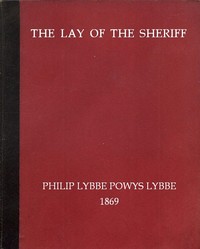
The Lay of the Sheriff — Story, Setting & Ideas can be approached with a clearer sense of reading commitment from its source measurements: 8,220 words, 36 min estimated reading time, and 2 detected text sections.
The text analysis averages about 20.0 words per sentence, while the detected sections provide another way to judge how the source is divided.
Project Gutenberg metadata also associates the work with “Vanderstegen, John -- Poetry,” connecting these edition facts with the source record’s subject description.
Explore this collection
These alternatives are selected using recorded categories and estimated reading time.
About 36 minutes
Historical Psychological Social Fiction
8,070 recorded words. 0 minutes difference from this book's estimate.
View Gutenberg source #36321About 34 minutes
Historical Psychological Social Fiction
7,711 recorded words. 2 minutes difference from this book's estimate.
View Gutenberg source #64170About 39 minutes
Historical Psychological Social Fiction
8,912 recorded words. 3 minutes difference from this book's estimate.
View Gutenberg source #13649Search stored excerpts and compare books → Choose by your preferences →
Choices use stored catalog measurements. Estimates vary with reading speed. A shared category is a catalog label, not a claim that two books have the same argument or literary quality.
Search reads excerpt text stored with this catalog and links to its associated Gutenberg record. The connection is stored in the site database; this tool does not recheck that every excerpt is word-for-word identical to that external record. Excerpt search does not cover every chapter and does not verify historical publication dates.
Catalog snapshot checked: 2026-09-25. Coverage: 95 public books, 95 available source excerpts.
Read the complete public-domain text at its original source.
Read on Project GutenbergThe poem opens with a prologue spoken by Mrs. Vanderstegen, the sheriff's mother, who addresses fiddlers, drums, and 'marrow bones and cleavers' in a deliberately overblown style. Her exclamation 'I must be Mrs. Van!' and the footnote explaining that locals abbreviated the family name establish a tone of affectionate self-mockery. The author, Philip Lybbe Powys Lybbe, dedicates the work to a clergyman and prints it for private circulation, signaling an insider audience familiar with Oxfordshire society.
Mrs. Vanderstegen's prologue sets the poem's dominant mode: a comic, domestic perspective on public office. She lists her household treasures—'tamarinds, nuts,' 'brocaded dresses,' and 'my old shay'—alongside the 'red-nosed Bob' who drives her. The humor derives from her inability to believe her good fortune: 'Is't true? can such felicity be mine? / It glads me more than all my currant wine!' The author's footnote boasts that Cane End currant wine 'was noted for its goodness,' blending personal anecdote with the poem's mock-heroic frame. Her exit line, urging the crowd to 'bellow hurrahs for Henry and for me,' reveals the poem's central conceit: the sheriff's office as a family triumph rather than a legal one.
Part II moves to the 'Star' hotel, where the Grand Jury Dinner becomes a scene of farce. The sheriff falls asleep, and attempts to rouse him—'Old Ashurst kicks, and kicks his shins again'—fail until Fane proposes to 'black our sheriff's nose.' The author disclaims firsthand knowledge in a footnote, admitting he 'cannot be responsible for the concluding scene' but deems it plausible 'from his personal knowledge of the parties.' This careful hedging, combined with footnotes identifying real figures like John Fane and J. W. Henley, turns the poem into a roman à clef for Oxfordshire insiders. The satire extends to college fellows who 'sweat their Fellowships, then marry wives' and 'drone and doze in dull solemnity.'
Part III shifts tone abruptly, addressing female readers directly: 'Can it be fitting, think ye, e'er to bend / Justice to Pleasure's gay voluptuous end?' The speaker questions the propriety of the 'gay Assize Ball' and appeals to women's 'innate modesty.' He anticipates dismissal as 'some scribbler's cant' or 'Methodistic rant,' but insists on his sincerity. The passage contrasts 'art's consummate care' in dress and adornment with the sober duties of judges and juries. This moralizing section, though brief, introduces a note of earnestness that complicates the poem's otherwise jocular surface, suggesting the author's genuine concern for the dignity of legal proceedings.
The poem's extensive footnotes function almost as a parallel narrative. They identify local figures, explain jokes, and offer disclaimers. For example, the note on 'topp'd the tree' clarifies that the expression is 'metaphorical' because college heads 'would be doubtless unable, from the expanse of waistcoat, to top a tree.' Another footnote praises the 'most Rev. the Prases of St. John's College' as 'an honour to our College, our University, and our County.' These asides create a conversational, gossipy tone and anchor the poem in specific Oxfordshire networks. The author's voice—at once self-deprecating and proud—emerges more clearly in the notes than in the verse itself.
Readers should attend to the interplay between verse and footnote: the poem's humor often depends on knowing who is being named or teased. The irregular meter and variable line lengths reflect the author's amateur status, but also suit the mock-heroic mode. The work rewards those interested in Victorian county society, private printing, and the intersection of legal ceremony with family pride.
Reading about the sheriff’s ceremonious self-mockery reminded me of an old neighbour who recited his own failings at every village fête, half-proud, half-sorry. That same gentle irony echoes through Misrepresentative Men — Themes and Context, where flawed figures wear their wreaths crookedly. I felt the same warmth there, as if someone had left a lamp burning in a crooked hallway. Misrepresentative Men — Themes and Context
Use these questions to collect your thoughts before moving on.









