About 62 minutes
Songs of Childhood — Themes and Context
Fantasy Juvenile Worlds
14,247 recorded words. 5 minutes difference from this book's estimate.
View Gutenberg source #23545
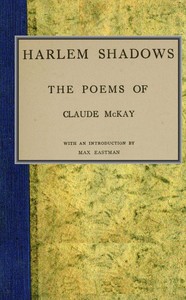
For Harlem shadows — Key Ideas to Explore, the stored edition analysis reports 15,351 words, 1 hr 7 min estimated reading time, and 4 detected text sections.
The text analysis averages about 26.2 words per sentence, while the detected sections provide another way to judge how the source is divided.
Project Gutenberg metadata also associates the work with “African Americans -- Poetry,” connecting these edition facts with the source record’s subject description.
Explore this collection
These alternatives are selected using recorded categories and estimated reading time.
About 62 minutes
Fantasy Juvenile Worlds
14,247 recorded words. 5 minutes difference from this book's estimate.
View Gutenberg source #23545About 59 minutes
Fantasy Juvenile Worlds
13,408 recorded words. 8 minutes difference from this book's estimate.
View Gutenberg source #31027About 59 minutes
Fantasy Juvenile Worlds
13,410 recorded words. 8 minutes difference from this book's estimate.
View Gutenberg source #34269Search stored excerpts and compare books → Choose by your preferences →
Choices use stored catalog measurements. Estimates vary with reading speed. A shared category is a catalog label, not a claim that two books have the same argument or literary quality.
Search reads excerpt text stored with this catalog and links to its associated Gutenberg record. The connection is stored in the site database; this tool does not recheck that every excerpt is word-for-word identical to that external record. Excerpt search does not cover every chapter and does not verify historical publication dates.
Catalog snapshot checked: 2026-09-25. Coverage: 95 public books, 95 available source excerpts.
Read the complete public-domain text at its original source.
Read on Project GutenbergClaude McKay's Harlem Shadows (1922) opens with an introduction by Max Eastman that frames the poet as a 'pure blooded Negro' whose work 'vividly enriches' American literature. Eastman's framing—emphasizing racial authenticity while claiming universal appeal—sets a complex stage for the poems that follow. McKay's own 'Author's Word' is not included in the excerpts, but the contents list reveals a poet moving between sonnets, quatrains, and free verse, addressing subjects from lynching to love, from Harlem streets to Jamaican landscapes.
The catalog assigns this work to 'African Americans—Poetry,' 'Harlem (New York, N.Y.)—Poetry,' and 'Jamaican Americans—Poetry.' These labels are accurate but incomplete. Poems like 'The Tropics in New York' and 'Home Thoughts' explicitly recall Jamaican scenes—'bananas ripe and green, and ginger-root'—while 'Harlem Shadows' and 'The Harlem Dancer' depict urban nightlife. Yet McKay also writes sonnets on abstract themes: 'I Know My Soul' contemplates fate and control, and 'Birds of Prey' allegorizes exploitation without specifying race or place. The collection's range exceeds its cataloging, including love poems ('Flower of Love'), nature pieces ('The Snow Fairy'), and meditations on death ('When I Have Passed Away').
McKay frequently employs the sonnet form, a European tradition he adapts to his own purposes. 'America,' 'The Lynching,' and 'If We Must Die' are all sonnets, the last becoming a famous call to resistance. In 'The Lynching,' the octave describes a lynching's aftermath—'His Spirit in smoke ascended to high heaven'—while the sestet shifts to the crowd's reaction: 'little lads, lynchers that were to be, / Danced round the dreadful thing in fiendish glee.' The formal control contrasts with the horror, creating tension. Not all poems are sonnets; 'Exhortation: Summer, 1919' uses long, incantatory lines and a refrain, while 'The Castaways' employs a looser rhyme scheme. This variety shows McKay experimenting within and against traditional forms.
Across the excerpts, McKay returns to images of light and shadow, often linked to racial experience. The title poem 'Harlem Shadows' likely explores this, but even in 'The Castaways,' the speaker sees 'life's shadows dark and deep' on park benches. 'Birds of Prey' describes predators that 'dim the sunshine of our day.' The body is another recurrent focus: in 'Baptism,' the speaker declares 'I will go naked in—for thus 'tis sweet' into the furnace, a metaphor for trial. 'The Lynching' dwells on the 'ghastly body swaying in the sun.' These physical images ground abstract themes in visceral, concrete detail, making the poems' emotional impact immediate.
Readers approaching Harlem Shadows should attend to how McKay balances personal lyricism with political commentary, often within the same poem. The sonnets reward close reading for their volta and compression, while the longer poems reveal his rhetorical range. The introduction by Max Eastman offers a contemporary white critic's perspective, but McKay's own voice—in its shifts from Jamaican patois to formal English—demands independent attention. This edition preserves the original 1922 arrangement, allowing readers to trace the poet's thematic and formal development across the collection.
Some nights, reading McKay’s Harlem shadows, I felt the ache of two homes at once—the warmth of memory against the city’s cold edges. It reminded me of an old collection found by chance, where young voices met the same quiet questions. There’s a gentleness in that, I think: Golden Numbers: A Book of Verse for Youth — Themes and Context holds its own kind of lingering light, soft and unhurried.
A brief reflection can help important ideas stay with you longer.









