About 23 minutes
An Old Man's Prayer — Background and Themes
Fantasy Juvenile Worlds
5,128 recorded words. 1 minutes difference from this book's estimate.
View Gutenberg source #47934
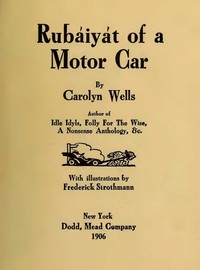
Rubáiyát of a Motor Car — Edition Insights can be approached with a clearer sense of reading commitment from its source measurements: 4,870 words, 22 min estimated reading time, and 1 detected text section.
The text analysis averages about 22.8 words per sentence, while the detected sections provide another way to judge how the source is divided.
Project Gutenberg metadata also associates the work with “Omar Khayyam -- Parodies, imitations, etc.,” connecting these edition facts with the source record’s subject description.
Explore this collection
These alternatives are selected using recorded categories and estimated reading time.
About 23 minutes
Fantasy Juvenile Worlds
5,128 recorded words. 1 minutes difference from this book's estimate.
View Gutenberg source #47934About 19 minutes
Fantasy Juvenile Worlds
4,196 recorded words. 3 minutes difference from this book's estimate.
View Gutenberg source #1065About 25 minutes
Fantasy Juvenile Worlds
5,722 recorded words. 3 minutes difference from this book's estimate.
View Gutenberg source #27424Search stored excerpts and compare books → Choose by your preferences →
Choices use stored catalog measurements. Estimates vary with reading speed. A shared category is a catalog label, not a claim that two books have the same argument or literary quality.
Search reads excerpt text stored with this catalog and links to its associated Gutenberg record. The connection is stored in the site database; this tool does not recheck that every excerpt is word-for-word identical to that external record. Excerpt search does not cover every chapter and does not verify historical publication dates.
Catalog snapshot checked: 2026-09-25. Coverage: 95 public books, 95 available source excerpts.
Read the complete public-domain text at its original source.
Read on Project GutenbergCarolyn Wells’s Rubáiyát of a Motor Car (1906) transposes the quatrains of Omar Khayyám into a comic celebration of early automobile culture. The opening stanza immediately replaces the Persian poet’s dawn call with a honking horn that “scatters into flight / The Hens before it in a Flapping Fright.” This collision of pastoral imagery with mechanical noise sets the pattern: the old world of poetry is invaded by the new world of engines, gasoline, and catalogues.
Wells does not merely update Khayyám’s themes; she exploits the tension between the original’s carpe diem philosophy and the motorist’s practical obsessions. Where the Rubáiyát urges us to seize the moment, Wells’s speaker seizes the steering wheel—and immediately confronts breakdowns, brand rivalries, and the relentless obsolescence of each year’s models.
Wells preserves the Rubáiyát’s characteristic aaba rhyme scheme but fills it with anachronistic vocabulary: “crank,” “valve,” “sprocket drum,” “jockey-pulley.” The formal constraint forces technical terms into the meter, producing lines like “Come, fill the Tank, adjust the Valve and Spring.” The effect is a deliberate awkwardness that mirrors the unreliability of early cars.
Several stanzas hinge on a single pun or substitution. “The Wine of Life is in a Motor Trip” replaces Khayyám’s grape with gasoline, while “The Bird Of Time wants but to get away” is glossed as “(I think that name’s a rather Clever Thing!)”—a self-aware wink at the forced analogy. Wells also inverts the original’s gravity: where Khayyám’s “moving finger” writes and moves on, Wells’s finger cranks a car that may or may not start.
The poem’s central tension is between the promise of freedom and the reality of breakdowns. The speaker celebrates “Automobile Elation” but immediately adds “(Though all the Parts keep breaking One by One!).” This parenthetical complaint recurs throughout: the car is both a “Glorious Game” and a “Toy on which one spends a Pile.”
Wells satirizes the early adopter’s dilemma. “Each Year a Hundred Models brings,” she writes, “but who buys the Car of Yesterday?” The speaker pores over catalogues, debates gear-driven versus jockey-pulley systems, and hears salesmen argue that red paint or a louder horn makes a car superior. The quatrains capture the frenzy of a market where last year’s model instantly becomes obsolete—a pattern familiar to modern readers.
Wells dedicates the book “To the crank that makes the machine go,” a pun that collapses the mechanical crank with the eccentric enthusiast. The dedication sets a tone of affectionate mockery. Yet the poem’s relationship to its source is not purely satirical: it borrows Khayyám’s structure of carpe diem stanzas, but the urgency is now directed at buying, repairing, and upgrading a car.
The excerpts do not reveal whether the poem maintains this comic tone throughout or shifts toward genuine frustration. The speaker’s complaint that “all the Parts keep breaking One by One” hints at a darker undercurrent, but the surviving stanzas remain buoyant. Readers familiar with the original Rubáiyát will notice which themes Wells omits—death, fate, the unknowable—and which she amplifies: brand loyalty, mechanical tinkering, and the thrill of speed.
This edition preserves Frederick Strothmann’s original illustrations, which complement Wells’s visual puns. Readers may wish to compare specific quatrains with FitzGerald’s translation to see how Wells transforms philosophical resignation into automotive exasperation. The poem is best read as a period piece—a snapshot of 1906 motoring culture—but its jokes about planned obsolescence and salesman hype remain sharp more than a century later.
Years among these shelves have taught me that humor often hides the deepest truths. That Rubáiyát of a Motor Car grumbles about clanking engines, yet beneath the gasoline wit lies a gentle sigh at our frantic modern ways. Oddly, it whispers in kinship with the older Humors Looking Glasse — Reading Notes, both laughing softly at the absurd mirrors we hold up to ourselves.
A brief reflection can help important ideas stay with you longer.









