About 389 minutes
The Ship of Fools, Volume 1 — Themes and Context
Science Fiction Utopias
89,385 recorded words. 11 minutes difference from this book's estimate.
View Gutenberg source #20179
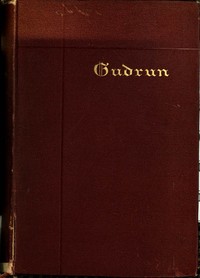
This digital edition of Gudrun: A Mediaeval Epic — Background and Themes is described by source-level measurements including 86,831 words, 6 hr 18 min estimated reading time, and 19 detected text sections.
The text analysis averages about 24.1 words per sentence, while the detected sections provide another way to judge how the source is divided.
Project Gutenberg metadata also associates the work with “Epic poetry, German -- Translations into English,” connecting these edition facts with the source record’s subject description.
Explore this collection
These alternatives are selected using recorded categories and estimated reading time.
About 389 minutes
Science Fiction Utopias
89,385 recorded words. 11 minutes difference from this book's estimate.
View Gutenberg source #20179About 457 minutes
Science Fiction Utopias
105,076 recorded words. 79 minutes difference from this book's estimate.
View Gutenberg source #47143About 241 minutes
Science Fiction Utopias
55,293 recorded words. 137 minutes difference from this book's estimate.
View Gutenberg source #29574Search stored excerpts and compare books → Choose by your preferences →
Choices use stored catalog measurements. Estimates vary with reading speed. A shared category is a catalog label, not a claim that two books have the same argument or literary quality.
Search reads excerpt text stored with this catalog and links to its associated Gutenberg record. The connection is stored in the site database; this tool does not recheck that every excerpt is word-for-word identical to that external record. Excerpt search does not cover every chapter and does not verify historical publication dates.
Catalog snapshot checked: 2026-09-25. Coverage: 95 public books, 95 available source excerpts.
Read the complete public-domain text at its original source.
Read on Project GutenbergMary Pickering Nichols's 1889 translation of the Middle High German epic Gudrun is cataloged under Science Fiction & Utopias, a classification that finds no support in the excerpts. The poem instead recounts a brutal cycle of abduction and retaliation set along the North Sea. In the opening of Tale the Seventeenth, King Hettel pursues his stolen daughter across the sea to the Wulpensand, a “broad, low island” where the Norman king Ludwig and his son Hartmut have taken refuge. The narrative voice is stark: “the food was left on shipboard, so old Wâ-te chooses,” and the pilgrims are left mourning. The catalog’s secondary topics—mythology-classics and fantasy-folklore—are more apt, but the text itself resists any utopian or futuristic reading.
The Project Gutenberg record assigns Gudrun to Science Fiction & Utopias, yet the excerpts contain no speculative technology, future societies, or idealized worlds. Instead, the poem dwells on concrete details of ships, shields, and seashore camps. King Ludwig’s men are “tossing on the wave” and “helmets brightly shining” are the only marvels. The catalog’s secondary topics—mythology-classics and fantasy-folklore—better reflect the work’s reliance on legendary motifs, such as the “old Wâ-te” who is “stern and never smiling.” The mismatch suggests that the cataloging may have been automated or based on a broad interpretation of “epic” as fantastical, but the text itself offers no evidence of science fiction or utopian themes.
Nichols’s translation employs a deliberately archaic English, with inverted word order (“Now saw King Ludwig’s sailors”) and a consistent four-stress line that mimics the original Middle High German meter. The excerpts show a preference for compound epithets like “bold, unyielding warrior” and “very high-born maidens.” The translator also retains the original stanza numbers (e.g., [843]), preserving the poem’s structural divisions. This fidelity to the source’s form, however, sometimes produces awkward phrasing: “I ween the God in heaven saw the wrong, and his anger showed on the morrow.” The effect is a hybrid of medieval flavor and Victorian poetic convention, neither fully modern nor authentically archaic.
The poem’s geography is both specific and vague. The Wulpensand is described as a “broad, low island” where “fires upon the seashore were seen on every side.” Other place names—Matelan, Hegeling kingdom—are mentioned without clear real-world equivalents. The translator’s preface notes that “very vague ideas of geography were entertained by the poet,” and the excerpts confirm this: ships move between “Ireland and Normandy” and “Holland, Denmark, and Friesland” with little regard for distance. Violence is immediate and physical: “rudders strained and cracking,” “helmets brightly shining,” and the threat of “grimmest foes.” The sea is not a romantic backdrop but a space of pursuit and ambush, where “the ships were turned so quickly” and men are “bewildered” by the sudden attack.
Readers approaching this translation should set aside the catalog’s Science Fiction label and instead attend to the poem’s oral-formulaic style, its focus on clan loyalty and revenge, and the translator’s choices in rendering a medieval Germanic epic for a Victorian audience. The incomplete excerpts offer only a fragment of the full narrative, but they reveal a work firmly rooted in the conventions of heroic poetry, not speculative fiction.
There’s something haunting about Gudrun—all that salt wind and stubborn loyalty, a world where every quiet moment feels borrowed. It reminds me of the tenderness tucked inside The Lay of Marie and Vignettes in Verse — A Reader’s Guide, where the old songs ache just as gently. Both left me staring out a window, thinking about all the stories we carry without ever saying aloud.
Capture what you thought, learned, and would like to remember.









