About 199 minutes
The Lay of Marie and Vignettes in Verse — A Reader’s Guide
Science Fiction Utopias
45,658 recorded words. 42 minutes difference from this book's estimate.
View Gutenberg source #11857
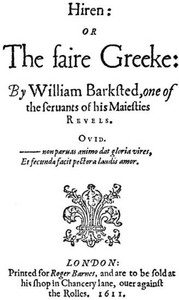
Before opening Seven Minor Epics of the English Renaissance (1596-1624) — A Reader’s Guide, the edition data offers a quick orientation: 55,293 words, 4 hr 1 min estimated reading time, and 7 detected text sections.
The text analysis averages about 31.3 words per sentence, while the detected sections provide another way to judge how the source is divided.
Project Gutenberg metadata also associates the work with “English poetry -- Early modern, 1500-1700,” connecting these edition facts with the source record’s subject description.
Explore this collection
These alternatives are selected using recorded categories and estimated reading time.
About 199 minutes
Science Fiction Utopias
45,658 recorded words. 42 minutes difference from this book's estimate.
View Gutenberg source #11857About 126 minutes
Science Fiction Utopias
28,761 recorded words. 115 minutes difference from this book's estimate.
View Gutenberg source #4099About 378 minutes
Science Fiction Utopias
86,831 recorded words. 137 minutes difference from this book's estimate.
View Gutenberg source #46109Search stored excerpts and compare books → Choose by your preferences →
Choices use stored catalog measurements. Estimates vary with reading speed. A shared category is a catalog label, not a claim that two books have the same argument or literary quality.
Search reads excerpt text stored with this catalog and links to its associated Gutenberg record. The connection is stored in the site database; this tool does not recheck that every excerpt is word-for-word identical to that external record. Excerpt search does not cover every chapter and does not verify historical publication dates.
Catalog snapshot checked: 2026-09-25. Coverage: 95 public books, 95 available source excerpts.
Read the complete public-domain text at its original source.
Read on Project GutenbergThe seven poems in this facsimile edition, originally published between 1596 and 1624, are presented as a supplement to Elizabeth Story Donno's Elizabethan Minor Epics. The editor, Paul W. Miller, notes that three of them—Philos and Licia, Dunstan Gale's Pyramus and Thisbe, and Samuel Page's The Love of Amos and Laura—had not been reprinted in modern times before this 1967 volume. The excerpts reveal a consistent reliance on Ovidian mythology and elaborate rhetorical structures, with poets like William Barksted weaving dense allusions to figures such as Orpheus, Eurydice, and Venus.
Project Gutenberg assigns this record to 'Science Fiction & Utopias,' a category that finds no support in the excerpts. The poems draw on classical mythology and Renaissance love narratives, not speculative futures or ideal societies. The catalog also lists 'Epic poetry, English' and 'Renaissance — England,' which align better with the content: the poems are brief, Ovidian narratives—often called epyllia—that flourished in the late Elizabethan and Jacobean periods. The mismatch suggests a cataloging error or an overly broad classification.
Barksted's Mirrha exemplifies the period's taste for mythological allusion and ornate speech. The excerpt features a lengthy seduction speech in which the speaker compares himself to Orpheus and claims Mirrha's voice could 'fetch back Euridice.' The verse is packed with classical references: Salmacis, Clitie, Leucothoe, Phaeton, and Cinyras appear within a few lines. The style is self-consciously artificial, with the speaker declaring 'My barren braine, can bless me with no store / Of able Epithits' even as he piles on elaborate compliments. This rhetorical density is characteristic of the minor epic genre, which prized wit and learning over narrative economy.
Paul W. Miller's introduction frames the volume as a scholarly tool, making available 'faithful reproductions of the earliest extant editions.' The facsimile format preserves original spelling, typography, and page layout, which is evident in the irregular lineation and archaic typography of the excerpts. Miller also notes that one poem, Philos and Licia, survives in a unique copy from Robert Burton's library. The volume thus serves as a primary source for studying textual transmission and the material conditions of Renaissance poetry, though the excerpts alone do not reveal the full editorial apparatus or the condition of the originals.
Readers approaching this collection should expect dense, allusive verse that rewards close attention to mythological references and rhetorical structure. The facsimile format means that spelling and punctuation reflect early modern printing practices, which may require patience. The poems are best read alongside Donno's anthology for a fuller picture of the minor epic genre, and the catalog subject should be disregarded as misleading.
The rain tapped at the pane while I lingered over the ornate rhetoric of those minor epics, their mythological figures grand but oddly distant. That afternoon, the excess felt like a weight. Later, closing the cover, my hand drifted instead to Two Women, 1862; a Poem — Text and Context, which suddenly seemed quieter, a different kind of epic altogether.
Build a private reading journal entry for this title.









