About 83 minutes
Evangeline: A Tale of Acadie — Story, Setting & Ideas
Science Fiction Utopias
19,012 recorded words. 8 minutes difference from this book's estimate.
View Gutenberg source #2039
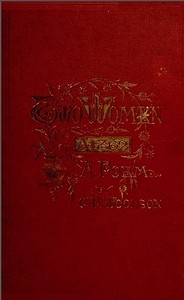
This digital edition of Two Women, 1862; a Poem — Text and Context is described by source-level measurements including 17,104 words, 1 hr 15 min estimated reading time, and 4 detected text sections.
The text analysis averages about 16.8 words per sentence, while the detected sections provide another way to judge how the source is divided.
Project Gutenberg metadata also associates the work with “United States -- History -- Civil War, 1861-1865 -- Poetry,” connecting these edition facts with the source record’s subject description.
Explore this collection
These alternatives are selected using recorded categories and estimated reading time.
About 83 minutes
Science Fiction Utopias
19,012 recorded words. 8 minutes difference from this book's estimate.
View Gutenberg source #2039About 67 minutes
Science Fiction Utopias
15,336 recorded words. 8 minutes difference from this book's estimate.
View Gutenberg source #37648About 55 minutes
Science Fiction Utopias
12,525 recorded words. 20 minutes difference from this book's estimate.
View Gutenberg source #51719Search stored excerpts and compare books → Choose by your preferences →
Choices use stored catalog measurements. Estimates vary with reading speed. A shared category is a catalog label, not a claim that two books have the same argument or literary quality.
Search reads excerpt text stored with this catalog and links to its associated Gutenberg record. The connection is stored in the site database; this tool does not recheck that every excerpt is word-for-word identical to that external record. Excerpt search does not cover every chapter and does not verify historical publication dates.
Catalog snapshot checked: 2026-09-25. Coverage: 95 public books, 95 available source excerpts.
Read the complete public-domain text at its original source.
Read on Project GutenbergConstance Fenimore Woolson's Two Women, 1862; a Poem opens with a striking contrast in narrative voice. The first section, titled “ONE,” adopts a leisurely, descriptive pace, lingering on the Ohio landscape with images of “green cornfields” and “brown bees.” The verse moves with the train “south through the lowlands,” yet the rhythm is unhurried, mirroring the maiden's calm, “home-bred air.” In contrast, “THE OTHER” begins with urgent, clipped lines: “West from the Capital’s crowded throng / The fiery engine rushed along.” The diction shifts to words like “danger,” “midnight,” and “defiance,” and the pace accelerates, reflecting the chaotic, war-torn setting. This structural bifurcation—two distinct narrative voices for two women—establishes the poem's central tension between innocence and experience, stillness and motion.
Woolson differentiates the two women through their speech patterns and vocabulary. The Maiden speaks in measured, morally certain terms: “In the sight / Of Heaven we are betrothed; I cannot break / My word.” Her language is direct, religious, and resolute, using words like “duty” and “sin.” The Lady, by contrast, employs a more passionate, self-dramatizing rhetoric: “Ah, let me kneel; thus I implore / That thou wouldst yield him to me.” Her speech is filled with exclamations and conditional clauses (“should he ask your grace”), revealing a mind that dwells on hypotheticals and emotional extremes. The Lady even questions the Maiden's faith, calling it “broader than its own,” while the Maiden accuses her of “atheism.” These linguistic choices do not merely convey personality; they embody opposing worldviews—one anchored in divine order, the other in human desire.
The poem's pace shifts dramatically between sections and even within dialogues. The opening description of the train journey uses enjambment and long, flowing lines to evoke a pastoral calm: “Through miles of green cornfields that lusty / And strong face the sun and rejoice.” As the narrative moves to the other woman, the meter tightens. Lines become shorter, more staccato: “The conductor’s lantern moves along, / Slowly lighting the motley throng.” The word “motley” recurs, emphasizing the chaotic assembly of soldiers, spies, and speculators. In the dialogue between the two women, the pace slows again, allowing for extended philosophical exchange. The Lady's aside—“I’ve whiled the time away; but, thou dear God, / Who made me, how with bleeding feet have trod / The toiling moments through my heart!”—introduces a sudden, introspective pause, contrasting with the earlier urgency. Woolson uses these rhythmic shifts to mirror the emotional and physical landscapes of war.
Woolson weaves specific images throughout the poem that reinforce the thematic opposition. The Maiden is associated with pastoral, natural imagery: “A lily turned nun,” “faint gold of her hair,” “quaint little gown.” These details emphasize purity and withdrawal. The Lady, though less described physically, is linked to fire and motion: “fiery engine,” “burning tide / Of loving words.” The river appears in both sections—first as a “slow moving, brown tide” in Ohio, then as a barrier crossed at midnight. The train itself becomes a symbol of war's relentless advance: “Whistling defiance that echoed back / To mountain guerrillas burning the track.” Even the dialogue contains recurring motifs: the Maiden speaks of “the red scaffold’s stairs” and “duty’s call,” while the Lady invokes “annihilation” and “the kiss / That I do keep for thee.” These repeated images create a cohesive symbolic system without resolving the central conflict.
Readers attentive to language will find that Woolson's poem rewards close analysis of its shifting registers. The two women's voices are not merely opposed but interwoven, each revealing the other's limitations. The poem's pace—now languid, now urgent—mirrors the uncertainty of war itself. Rather than seeking a clear victor in the debate, consider how Woolson uses poetic form to hold these tensions in balance, leaving the reader to weigh the claims of duty and desire.
Sometimes I think of how Woolson’s two women, so different in their rhythms, both end up walking the same lonely ground. It reminds me of old Acadie—how Longfellow’s Evangeline also carried her quiet through a world that kept changing beneath her feet. I’ve revisited that poem more than once, just to hear the cadence again. Evangeline: A Tale of Acadie — Story, Setting & Ideas sits near my shelf like an old, familiar ache.
Use these questions to collect your thoughts before moving on.









