About 48 minutes
The Broadway Anthology — Text and Context
Science Fiction Utopias
10,916 recorded words. 7 minutes difference from this book's estimate.
View Gutenberg source #15120
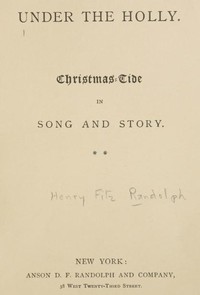
For Under the Holly: Christmas-Tide in Song and Story — Story, Setting & Ideas, the stored edition analysis reports 12,525 words, 55 min estimated reading time, and 2 detected text sections.
The text analysis averages about 22.8 words per sentence, while the detected sections provide another way to judge how the source is divided.
Project Gutenberg metadata also associates the work with “Christmas stories,” connecting these edition facts with the source record’s subject description.
Explore this collection
These alternatives are selected using recorded categories and estimated reading time.
About 48 minutes
Science Fiction Utopias
10,916 recorded words. 7 minutes difference from this book's estimate.
View Gutenberg source #15120About 45 minutes
Science Fiction Utopias
10,247 recorded words. 10 minutes difference from this book's estimate.
View Gutenberg source #55042About 44 minutes
Science Fiction Utopias
10,036 recorded words. 11 minutes difference from this book's estimate.
View Gutenberg source #8953Search stored excerpts and compare books → Choose by your preferences →
Choices use stored catalog measurements. Estimates vary with reading speed. A shared category is a catalog label, not a claim that two books have the same argument or literary quality.
Search reads excerpt text stored with this catalog and links to its associated Gutenberg record. The connection is stored in the site database; this tool does not recheck that every excerpt is word-for-word identical to that external record. Excerpt search does not cover every chapter and does not verify historical publication dates.
Catalog snapshot checked: 2026-09-25. Coverage: 95 public books, 95 available source excerpts.
Read the complete public-domain text at its original source.
Read on Project GutenbergThis 1887 anthology, compiled by Henry F. Randolph, gathers poems, carols, and prose excerpts that center on Christmas observance. The volume opens with Washington Irving's reflection on the festival's ability to blend "solemn and sacred feeling" with conviviality, a tone that recurs throughout. The compiler draws from diverse sources: a Hans Christian Andersen story, a Dickens scene from A Christmas Carol, and anonymous carols. The excerpts reveal a deliberate juxtaposition of sacred and domestic, from cathedral anthems to the Cratchits' hearthside toast. Randolph's editorial hand is light, letting the selections speak to the season's dual character of reverence and revelry.
The anthology repeatedly sets religious solemnity against worldly cheer. Irving describes Christmas as a time when "the services of the church" and "conviviality" merge, while a carol like "Christmas Carol" emphasizes the Nativity: "Child Jesus comes from heavenly height." Yet the Dickens excerpt shows the Cratchits' dinner, where Bob proposes a toast to Scrooge, the "Founder of the Feast," and Mrs. Cratchit reddens at the hypocrisy. The sacred is never far from the social; even Tiny Tim's song is about "a lost child travelling in the snow." This pattern suggests the compiler valued both the spiritual and the communal aspects of the holiday.
Several selections foreground children and the poor. Tiny Tim, with his "withered little hand," sits close to his father, and his plaintive song closes the Cratchit scene. Hans Christian Andersen's "The Little Match-girl" (included in the contents) likely continues this focus. An anonymous poem, "Last Night, as I Lay Sleeping," features a guardian angel singing to a boy: "Thy body be at rest, dear boy, thy soul be free from sin." The anthology also includes a "Rocking Hymn" and a lullaby. These pieces create a recurring motif of innocence and fragility, often set against the harshness of winter or poverty.
Randolph organizes the collection as a sequence of short pieces, moving from Irving's essay to carols, a lullaby, a poem about an oak tree, and then to Andersen and Dickens. The table of contents lists 14 items, including "Christmas Day in London" and "Under the Holly-bough." The illustrations are copied from an edition of Irving's Sketch Book with designs by Randolph Caldecott. This mix of American and European authors, verse and prose, suggests an attempt to create a varied but cohesive reading experience. The compiler does not provide commentary, letting the juxtapositions—such as the solemn "In Memoriam" following the festive "Rocking Hymn"—generate meaning.
Readers approaching this anthology should attend to the contrasts between its pieces: the cathedral organ versus the crackling chestnuts, the angel's carol versus Mrs. Cratchit's indignation. The excerpts are brief, so the full effect depends on how each selection colors the next. Consider the sequence as a deliberate arrangement, not a random gathering. The volume rewards those who notice how sacred and domestic, joyful and sorrowful, are held together under the holly.
I found myself thinking about the quiet hush in Under the Holly—how the old carols and stories made room for both warmth and reflection. That same stillness followed me into Two Women, 1862; a Poem — Text and Context, where a single moment stretches into something tender and unresolved. It felt less like reading and more like remembering something I hadn’t yet lived.
Create a short personal record of your experience with this book.









