About 44 minutes
The Norsk Nightingale; Being the Lyrics of a "Lumberyack" — Key Ideas to Explore
Science Fiction Utopias
10,036 recorded words. 1 minutes difference from this book's estimate.
View Gutenberg source #8953
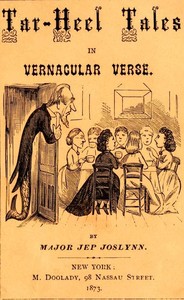
Tar-Heel Tales in Vernacular Verse — Background and Themes can be approached with a clearer sense of reading commitment from its source measurements: 10,247 words, 45 min estimated reading time, and 11 detected text sections.
The text analysis averages about 24.6 words per sentence, while the detected sections provide another way to judge how the source is divided.
Project Gutenberg metadata also associates the work with “North Carolina -- Poetry,” connecting these edition facts with the source record’s subject description.
Explore this collection
These alternatives are selected using recorded categories and estimated reading time.
About 44 minutes
Science Fiction Utopias
10,036 recorded words. 1 minutes difference from this book's estimate.
View Gutenberg source #8953About 44 minutes
Science Fiction Utopias
10,040 recorded words. 1 minutes difference from this book's estimate.
View Gutenberg source #19363About 43 minutes
Science Fiction Utopias
9,750 recorded words. 2 minutes difference from this book's estimate.
View Gutenberg source #36782Search stored excerpts and compare books → Choose by your preferences →
Choices use stored catalog measurements. Estimates vary with reading speed. A shared category is a catalog label, not a claim that two books have the same argument or literary quality.
Search reads excerpt text stored with this catalog and links to its associated Gutenberg record. The connection is stored in the site database; this tool does not recheck that every excerpt is word-for-word identical to that external record. Excerpt search does not cover every chapter and does not verify historical publication dates.
Catalog snapshot checked: 2026-09-25. Coverage: 95 public books, 95 available source excerpts.
Read the complete public-domain text at its original source.
Read on Project GutenbergThe author, J. E. P. Doyle, writing under the persona of Major Jep Joslynn, presents these verses as a record of stories heard from Tar-Heel refugees during Sherman's campaign in North Carolina. The preface grounds the work in a specific historical moment—the author served as a staff officer and listened to refugees in camp—and the poems themselves are cast as the Major's vernacular retellings. The result is a collection that oscillates between tall-tale humor and earnest moralizing, with dialect as its central stylistic feature.
The excerpts reveal a structure built around first-person anecdotes, often beginning with a direct address to a listener ("Elder" or "Hank Rowland") and unfolding as a yarn with a punchline or moral. The verse form is loose, favoring narrative momentum over strict meter, and the imagery draws heavily on the natural world of the North Carolina pineries: alligators, dogs, rafts, and swamps.
The collection is unified by the voice of Major Jep Joslynn, a persona who claims to have witnessed or heard the tales he recounts. In the preface, Doyle explains that he "created Major Jep Joslynn, and permitted him to weave some of these 'Tales' into verse." This framing device gives the poems a consistent oral quality: they are performances meant to be heard, not read silently. The Major often addresses a specific listener—"Elder" in one tale, "Hank Rowland" in another—creating a sense of intimacy and immediacy.
The dialect itself is a key part of the frame. Words like "rarftin'" (rafting), "berlieve" (believe), and "allergater" (alligator) are not merely phonetic spellings but markers of a regional identity that the Major embodies. The reader is positioned as an outsider being let in on local knowledge, a dynamic that the preface reinforces by asking "silence from pit to dome" while the Major entertains.
Across the excerpts, animals appear as both companions and threats. In the tale of the alligator, a little black dog named Fanny is snatched from a raft, only to be recovered alive months later inside the alligator's stomach, along with her puppies and a kennel of spruce logs. This grotesque, comic image—a dog emerging from a predator's belly—is the collection's most vivid recurring motif: the body as a container, the unexpected survival.
Water is another constant. Rafts on the Suwanee River, the swamp near Cedar Keys, and the "pineries" all situate the tales in a landscape of rivers and marshes. The alligator itself is a creature of the water, and the act of rafting—moving logs downriver—ties the human characters to the same environment. The body of the alligator, when cut open, yields not only the dog but also "spruce lorgs," blurring the line between animal and timber, nature and human labor.
The poems shift rapidly between settings, often within a single stanza. In the alligator tale, the narrator moves from the raft anchored near Cedar Keys, to sleep, to the cry of the dog, to pursuit in the dark, and then two months later to a swamp where he shoots the alligator. This jump in time is typical: the tales are structured as memories, with the narrator recalling an event from a later vantage point. The preface itself is a memory of wartime, and the poems are framed as recollections told to a listener in the present.
This movement is not always linear. In "Old Tom Gin," the narrator begins at a bar, then flashes back to his marriage and his past as a "topher," then returns to the present to refuse a drink. The effect is a layered sense of time, where the past intrudes on the present through the act of storytelling. The reader is never allowed to settle in one moment; the tales are always in motion, pulled between the event and its retelling.
The vernacular is not merely decorative but structural. Each poem begins with a direct address that establishes the speaker-listener relationship, and the dialect shapes the rhythm of the verse. In the alligator tale, the line "I'll take the yarn, as the whale tuk in Mr. Jonah, without any doubt" uses a biblical reference to frame the tall tale, while the dialect word "tuk" (took) keeps the language grounded in the speaker's voice. The meter is irregular, often following the natural stresses of speech rather than a fixed pattern.
The dialect also serves to authenticate the tales as local products. The preface emphasizes that the author studied "the habits and quaint dialect of this poor, but honest class," and the poems are presented as authentic transcriptions of refugee speech. Whether or not the dialect is accurate by modern standards, it functions as a marker of place and class, distinguishing these tales from more polished literary verse of the period. The result is a collection that asks to be read aloud, with the dialect guiding pronunciation and emphasis.
Readers approaching this collection should attend to the interplay between the author's framing and the Major's voice. The preface claims authenticity, but the poems are clearly crafted literary artifacts, blending observation with invention. The dialect rewards reading aloud, and the recurring images—animals, water, the body—create a cohesive world even as the tales range from comic to moralistic. The incomplete excerpts leave the full arc of the collection unclear, but the patterns of address, setting, and imagery offer a reliable entry point.
Sometimes a book stays with you like a familiar porch, and those Tar-Heel poems felt that way—full of voices trying to make sense of hardship. It reminded me of how quietly we carry our own reflections, much like the gentle introspection found in The Angel in the House — Reading Companion. That same softness lingered, somehow.
Capture what you thought, learned, and would like to remember.









