About 44 minutes
The Norsk Nightingale; Being the Lyrics of a "Lumberyack" — Key Ideas to Explore
Science Fiction Utopias
10,036 recorded words. 1 minutes difference from this book's estimate.
View Gutenberg source #8953
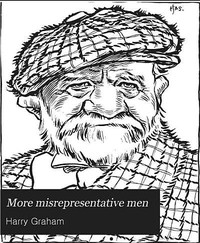
More Misrepresentative Men — A Reader’s Guide can be approached with a clearer sense of reading commitment from its source measurements: 9,750 words, 43 min estimated reading time, and 2 detected text sections.
The text analysis averages about 25.5 words per sentence, while the detected sections provide another way to judge how the source is divided.
Project Gutenberg metadata also associates the work with “Nonsense verses,” connecting these edition facts with the source record’s subject description.
Explore this collection
These alternatives are selected using recorded categories and estimated reading time.
About 44 minutes
Science Fiction Utopias
10,036 recorded words. 1 minutes difference from this book's estimate.
View Gutenberg source #8953About 44 minutes
Science Fiction Utopias
10,040 recorded words. 1 minutes difference from this book's estimate.
View Gutenberg source #19363About 45 minutes
Science Fiction Utopias
10,247 recorded words. 2 minutes difference from this book's estimate.
View Gutenberg source #55042Search stored excerpts and compare books → Choose by your preferences →
Choices use stored catalog measurements. Estimates vary with reading speed. A shared category is a catalog label, not a claim that two books have the same argument or literary quality.
Search reads excerpt text stored with this catalog and links to its associated Gutenberg record. The connection is stored in the site database; this tool does not recheck that every excerpt is word-for-word identical to that external record. Excerpt search does not cover every chapter and does not verify historical publication dates.
Catalog snapshot checked: 2026-09-25. Coverage: 95 public books, 95 available source excerpts.
Read the complete public-domain text at its original source.
Read on Project GutenbergThe book opens not with a poem but with a mock-serious 'Author's Foreword' addressed to the publisher, where Harry Graham portrays poets as beleaguered laborers 'toiling' for bread while publishers, like 'modern Circes,' turn verses into profit. The 'Publisher's Preface' replies in kind, accusing the author of 'grasping greed.' This framing device immediately establishes the collection's tone: self-aware, ironic, and playful about the business of writing.
Graham's targets range from Robert Burns to Sherlock Holmes, each poem a biographical sketch in verse that blends factual references with deliberate anachronism and parody. The excerpts show a preference for regular meter and rhyme, often undercut by colloquial asides or abrupt shifts in register.
The foreword and preface are not mere preliminaries; they are integral to the book's humor. Graham casts himself as a 'furtive jester' bound by contracts, while the publisher's voice is one of mock outrage. This exchange sets up a running joke about literary commerce that recurs in later poems. For instance, in 'Andrew Carnegie,' the speaker directly addresses the industrialist, asking him to 'order an immense supply' of the book for his libraries—a gag that only lands if the reader recalls the opening banter.
The preface also includes a playful threat: the publisher warns that if the author's verses fail, he will be 'fed on bread and water' and forced to write 'a better book.' This kind of metafictional wink is rare in early 20th-century comic verse and gives the collection a cohesive, almost theatrical structure.
Graham's poems mimic the structure of a biographical entry but subvert it with absurd details. In 'Andrew Carnegie,' the subject is introduced with mock-heroic gravity ('N Caledonia, stern and wild'), only to be described as a 'self-made' man who 'builded better than he knew.' The poem lists Carnegie's philanthropic projects—libraries for 'those who never learnt to read'—but undercuts the praise with a final stanza that begs for the author's own book to be stocked.
'King Cophetua' takes a different approach: Graham admits he is 'unwilling' to retell the story because Tennyson already did, then offers a 'free translation' into fractured French. This reliance on a well-known literary source, and the decision to render it in a foreign language for comic effect, shows Graham's willingness to experiment with form while mocking the very idea of original biography.
Graham's verse is technically accomplished, with consistent rhyme and meter that he occasionally disrupts for comic effect. In the 'Author's Foreword,' he uses a regular ABABCC rhyme scheme, but the content is deliberately prosaic: 'We poets at our desks are toiling, / To earn a modicum of bread.' The contrast between formal structure and mundane subject matter is a recurring device.
In 'Andrew Carnegie,' the line 'And lingual solecisms betoken / That Scotch is drunk, as well as spoken' plays on the double meaning of 'Scotch' (whisky and dialect). Similarly, 'King Cophetua' includes the parenthetical aside 'Express'd, as I need hardly mench: / In 4 a.m. (or early) French'—a pun on 'a.m.' that also mocks the pretension of translating into French. These linguistic jokes reward close reading.
Throughout the excerpts, Graham returns to the theme of writing for money. The 'Author's Foreword' concludes with a stanza addressed to the publisher: 'I love you, as I said before, / But oh! I love your money more!' This bluntness is typical of the collection's refusal to romanticize the poet's craft.
In 'Andrew Carnegie,' the speaker imagines the millionaire buying 'this foolish book of verses' to fill his libraries, and in 'King Cophetua,' the poet admits he is only retelling the story because it 'has been so often told' and he needs material. This self-deprecating stance—the poet as hack—runs counter to the lofty tone of traditional biographical verse and gives the collection a modern, cynical edge.
Graham's More Misrepresentative Men rewards readers who pay attention to its framing devices and metrical games. The poems are best approached not as straightforward biographies but as parodic performances that constantly remind us of their own artifice. The author-publisher quarrel, the mock-heroic postures, and the linguistic puns all contribute to a unified comic vision. For a first reading, focus on how each poem establishes its target and then undercuts it—often by turning the satire back on the poet himself.
I found myself thinking of quiet mornings with a volume of More Misrepresentative Men, where Harry Graham’s gentle jabs at fame never sting—they just smile. That playful weightlessness reminded me of another Saturday, turning pages of The Poetical Works of William Wordsworth — Volume 7 (of 8) — Text and Context. Different warmth, same patient company—one laughs softly, the other breathes meadows.
Capture what you thought, learned, and would like to remember.









