About 25 minutes
Cautionary Tales for Children — Reading Notes
Fantasy Juvenile Worlds
5,722 recorded words. 1 minutes difference from this book's estimate.
View Gutenberg source #27424
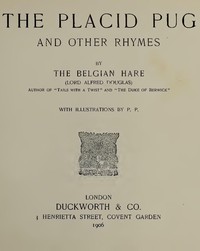
The Placid Pug, and Other Rhymes — Text and Context can be approached with a clearer sense of reading commitment from its source measurements: 5,796 words, 26 min estimated reading time, and 2 detected text sections.
The text analysis averages about 25.7 words per sentence, while the detected sections provide another way to judge how the source is divided.
Project Gutenberg metadata also associates the work with “Children's poetry, English,” connecting these edition facts with the source record’s subject description.
Explore this collection
These alternatives are selected using recorded categories and estimated reading time.
About 25 minutes
Fantasy Juvenile Worlds
5,722 recorded words. 1 minutes difference from this book's estimate.
View Gutenberg source #27424About 23 minutes
Fantasy Juvenile Worlds
5,128 recorded words. 3 minutes difference from this book's estimate.
View Gutenberg source #47934About 22 minutes
Fantasy Juvenile Worlds
4,870 recorded words. 4 minutes difference from this book's estimate.
View Gutenberg source #51064Search stored excerpts and compare books → Choose by your preferences →
Choices use stored catalog measurements. Estimates vary with reading speed. A shared category is a catalog label, not a claim that two books have the same argument or literary quality.
Search reads excerpt text stored with this catalog and links to its associated Gutenberg record. The connection is stored in the site database; this tool does not recheck that every excerpt is word-for-word identical to that external record. Excerpt search does not cover every chapter and does not verify historical publication dates.
Catalog snapshot checked: 2026-09-25. Coverage: 95 public books, 95 available source excerpts.
Read the complete public-domain text at its original source.
Read on Project GutenbergLord Alfred Douglas, writing under the pseudonym "the Belgian Hare," opens his 1906 collection with a poem that immediately undercuts the placidity promised by the title. The pug, led through the park in silk and leather, is contrasted with a shark in southern seas—a juxtaposition that sets the tone for the entire volume. The catalog subjects list this as children's poetry and humorous verse, but the excerpts reveal a sardonic, adult sensibility that uses animal figures to critique human behavior, from bishops to tourists.
The title poem, "The Placid Pug," establishes a pattern of using an animal to embody a human failing. The pug is described as living "in calm monotony," scarcely turning its "round protuberant eyes" to notice anything beyond a new biscuit. The poem's refrain—"The placid Pug that paces in the park"—becomes a mocking commentary on a life of comfort and ignorance. Douglas explicitly contrasts the pug with the shark, which "pursues the paths of his pulsating quest" in southern seas, suggesting that the pug's ease is a form of moral failure. The final stanza speculates that if pugs were raised in the sea, they might lead "more sane, more useful" lives, but the pug remains "untouched by thoughts of all that might have been." This is not a gentle animal rhyme; it is a pointed critique of complacency.
The collection's other poems extend this satirical method. "Ballad for Bishops" takes aim at clergy who bemoan declining birth rates by praising rabbits' prolific breeding. Douglas notes that rabbits produce "six times" a year and marry among close relations, ensuring a "constant stream of 'little strangers.'" The poem's mock-earnest tone—"these noble brutes, pure Duty's pendants"—mocks the bishops' logic by reducing human morality to animal fecundity. Similarly, "Hymn for Humble People" and "Versicles for Vegetarians" (listed in the contents but not excerpted) likely continue this pattern of using animal or natural imagery to deflate human pretension. The catalog subject "Humorous poetry, English" fits, but the humor is barbed, not gentle.
The closing poem, excerpted in part, features an oyster on the shore who "preserves his philosophic calm" amid the noise of tourists, a "Salvation Army on the beach," and a "milingtary band" that "poisons the air." The oyster "has no ear to lend" and "hates to interfere," but the poem's final line—"Chiefly because these rhymes must have an end"—breaks the fourth wall with a wry shrug. This self-aware conclusion suggests that the collection's satire is ultimately playful, not bitter. However, the excerpts include only two complete poems and fragments of a third, so the full range of the volume's targets and tones cannot be assessed. The catalog subject "Animals -- Juvenile poetry" is misleading: the animals are vehicles for adult satire, and the voice is anything but juvenile.
Readers approaching The Placid Pug, and Other Rhymes should set aside expectations of a conventional children's book. Douglas's verse is metrically polished and wittily rhymed, but its subjects—bishops, vintners, vegetarians, and the complacent middle class—suggest an audience of adults who appreciate irony. The animal figures are not cute; they are mirrors held up to human folly. The excerpts give a clear taste of Douglas's method, but the full collection likely contains further surprises in its treatment of the listed topics.
Years between them, yet I often shelve Lord Alfred’s pug beside the soldiers’ verses from Plattsburg. Both know the quiet joke of wearing a brave face. One satirizes the parlour, the other the parade ground; each finds our pretensions rather endearingly silly. A shared wink across decades, perhaps. I remember the dog’s placid stare inside Rookie rhymes, by the men of the 1st and 2nd provisional training regiments, Plattsburg, New York — Context and Discussion, and the young men’s marching wit—both simply human.
Create a short personal record of your experience with this book.









